
Can silicone keypads be backlit, and what are the common methods?
Yes, silicone keypads can absolutely be backlit — and when done correctly, backlighting transforms user experience, visibility, and product aesthetics. As a professional silicone keypad manufacturer, FromRubber has delivered millions of backlit keypads for medical devices, industrial controls, consumer electronics, and automotive interiors. This article explains all common backlighting methods, their pros and cons, and how to specify the right solution for your product.
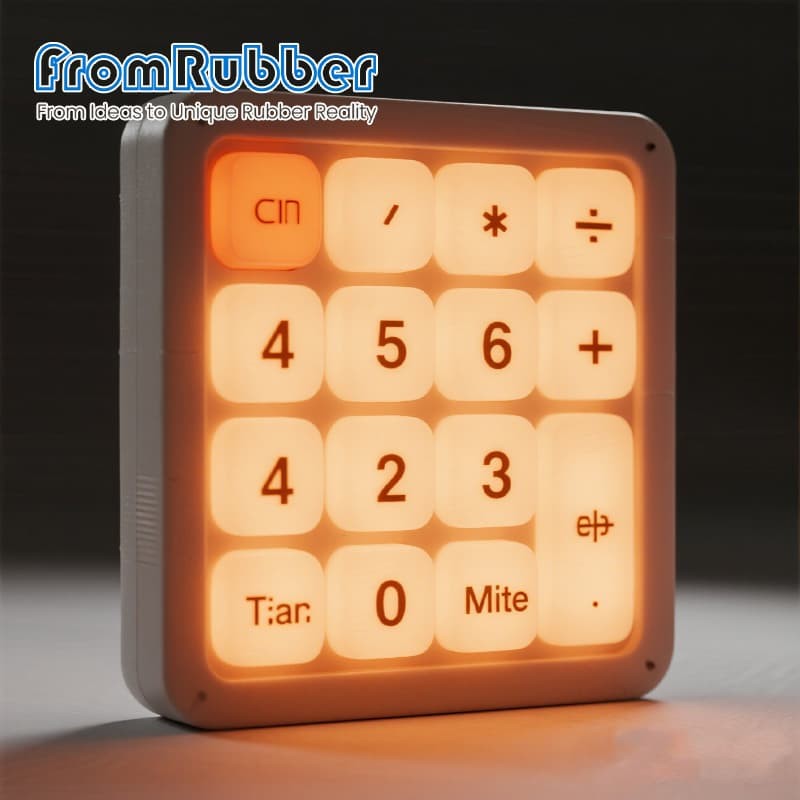
Why Backlight Silicone Keypads?
Backlighting is no longer a luxury — it's an expectation in low-light environments. From medical equipment in darkened operating rooms to automotive dashboards and industrial remote controls, illuminated keys improve accuracy, safety, and brand perception. Silicone keypads are uniquely suited to backlighting because silicone is naturally translucent and can be engineered to diffuse light evenly. However, not all backlighting methods are equal. The right choice depends on your required brightness, uniformity, power budget, thickness constraints, and production volume.
Method 1: LED Edge Lighting with Light Guide Film (LGF)
This is the most common and professional method for backlit silicone keypads. A thin light guide film (typically polycarbonate or acrylic) is placed beneath the silicone keypad. LEDs are mounted on the PCB at the edge of the guide film. Light couples into the film and is extracted upward by micro-optical patterns, illuminating the keys from below.
How it works
Light from edge-mounted LEDs travels through the LGF via total internal reflection, then scattered upward by printed dot patterns or micro-prisms beneath each key.
Very uniform illumination
Low power consumption (2-4 LEDs)
Thin overall stack-up (0.3-0.5mm LGF)
Can achieve multiple colors
Higher initial tooling cost
Requires precise alignment
Light guide adds component cost
Method 2: Direct SMD LED Under Each Key
For applications requiring maximum brightness or selective key illumination, SMD LEDs are placed directly on the PCB, positioned under each key or key cluster. The silicone keypad either has translucent plungers or secondary light-diffusing layers to spread the light.
How it works
High-brightness LEDs soldered to PCB. When key is pressed or idle, LED emits upward through translucent silicone rubber. Light may be diffused by texture or secondary silicone layer.
Highest brightness possible
Independent key illumination
No light guide tooling
Instant prototyping
Higher LED count/cost
Potential hot spots without diffusion
More PCB complexity
Method 3: Electroluminescent (EL) Backlighting
EL panels are thin, flexible phosphor-based sheets that emit light when excited by an AC voltage. They are placed beneath the silicone keypad and provide a cool, even glow across the entire keypad area without individual hotspots.
How it works
An EL panel (0.2-0.5mm thick) sandwiched between keypad and PCB. An inverter converts DC battery voltage to AC (100-400Hz, 100V). The phosphor layer glows uniformly.
Extremely uniform light
Very thin and flexible
Low power (consumes ~1-2mA per cm²)
No LED hotspots
Requires inverter (adds cost)
Limited color options (typically blue-green)
Brightness degrades over time (5000-10000 hours)
Not as bright as LEDs
Method 4: Fiber Optic Backlighting
Specialty method for rugged or high-reliability applications. Side-emitting optical fibers are routed through or beneath the silicone keypad with a single high-power LED or laser source. Rare in consumer goods but used in military and medical equipment.
How it works
A single bright LED couples into fiber optic bundle. Fibers are woven into a mat or routed to each key. Light escapes through micro-bends or side-glowing cladding.
No EMI generation
Single light source
Can be very waterproof
Long lifetime
Very high cost
Complex assembly
Not flexible for design changes
Comparison of Backlighting Methods for Silicone Keypads
| Method | Uniformity | Brightness | Thickness added | Relative Cost | Best For |
|---|---|---|---|---|---|
| LED + LGF | Excellent | High | 0.4-0.8mm | $$ (Moderate) | Most consumer/industrial keypads |
| Direct SMD LEDs | Good (with diffuser) | Very High | Minimal | $$$ (LED count dependent) | High brightness, selective keys |
| EL Panel | Perfect | Low-Medium | 0.3-0.5mm | $$ (plus inverter) | Even glow, power-sensitive |
| Fiber Optic | Good | Medium | 1-2mm | $$$$ | EMI-sensitive, rugged |
Special Technique: Laser-Engraved Legends with Backlight Bleed
For a premium look, many silicone keypads are manufactured with a top spray coating (black or dark color) and translucent silicone underneath. The key legends are laser-engraved through the top coating. When backlit from below, light passes only through the engraved characters, creating sharp, luminous symbols that are invisible when the backlight is off. FromRubber specializes in this "dark face" laser-engraved backlit keypad process, used by leading medical and automotive OEMs.
FromRubber — Your Backlit Silicone Keypad Manufacturing Partner
We design and produce custom backlit silicone keypads using all methods above. Our in-house tooling, laser engraving, and assembly ensure consistent quality and fast turnaround. Send us your requirements for a free feasibility review and quotation.
Request Backlit Keypad QuoteEmail: sales..........com | ISO 9001 | Rapid prototyping | Low to high volume
Key Design Considerations from FromRubber's Engineering Team
When specifying backlit silicone keypads, keep these factors in mind:
- Silicone translucency: Standard silicone is naturally translucent. For backlighting, avoid heavily filled or pigmented compounds unless using laser engraving.
- Keycap thickness: Thinner keycaps (1-2mm) transmit more light. Thicker domes may require higher LED brightness or dedicated light guides.
- Color & light blocking: Black silicone blocks most light. To backlight black keys, use laser engraving through a painted top layer.
- Environmental sealing: Backlighting components (LEDs, LGF, EL panels) can be integrated into waterproof keypad assemblies. FromRubber offers IP67-rated backlit keypads.
- Actuation force & travel: Adding light guide films may slightly increase stack height but does not affect tactile feel if designed correctly.
Real-World Applications of Backlit Silicone Keypads
FromRubber has supplied backlit silicone keypads for:
- Medical devices: Ultrasound consoles, patient monitors, surgical remote controls — EL or LGF backlighting for low glare.
- Automotive interiors: Steering wheel controls, HVAC panels, center consoles — direct LED or LGF with laser-engraved legends.
- Industrial handhelds: Rugged terminals for warehouse and field use — bright SMD LEDs with protective overmolding.
- Consumer electronics: Remote controls, gaming keypads, smart home interfaces — cost-effective LGF backlighting.
- Marine & outdoor equipment: Waterproof keypads with fiber optic or sealed LED backlighting.
Cost & Lead Time Comparison
| Method | Tooling Cost (approximate) | Unit Cost (high volume) | Typical Lead Time (prototype) |
|---|---|---|---|
| LED + LGF | Moderate (LGF tooling) | Low | 3-4 weeks |
| Direct SMD LEDs | Low (LED placement only) | Moderate (LED count) | 2-3 weeks |
| EL Panel | Low (EL die cut) | Low to Moderate | 2-3 weeks |
Frequently Asked Questions
Q: Can silicone keypads have different colors for different keys in backlighting?
A: Yes. With RGB LEDs or multiple colored LGF layers, different keys or zones can have different colors. FromRubber offers multi-color backlighting for high-end applications.
Q: Does backlighting affect the lifespan of silicone keypads?
A: No. The silicone material itself is unaffected by LED or EL backlighting. LEDs can last 50,000+ hours, far exceeding the mechanical life of most keypads (1-5 million cycles).
Q: Can I backlight a silicone keypad with clear or translucent keys only?
A: Translucent keys are best for even illumination, but laser-engraved black keypads also work beautifully. FromRubber can advise on material selection.
Q: What is the minimum quantity you accept for custom backlit silicone keypads?
A: We accept low-volume prototypes (100 pieces) for testing and design validation. Production MOQ depends on tooling complexity but typically starts at 1,000 pieces for custom keypads.
Conclusion: Silicone keypads can absolutely be backlit using several proven methods — LED with light guide films, direct SMD LEDs, electroluminescent panels, or fiber optics. Each method offers distinct advantages in brightness, uniformity, cost, and thickness. As an experienced silicone keypad manufacturer, FromRubber helps you select and implement the optimal backlighting solution for your product. Contact us to discuss your project.