
Is silicone rubber gasket resistant to oil and fuel, or will it swell and fail?
1. The Chemistry: Why Silicone Swells in Oil
Silicone rubber (VMQ) has a unique inorganic siloxane backbone (Si-O-Si) that gives it exceptional heat and UV resistance. However, this same open molecular structure allows non-polar fluids like mineral oils, gasoline, and diesel to penetrate the polymer matrix. The result: volume swell, loss of mechanical properties, and eventual seal failure. At Fromrubber, we've tested thousands of compounds—standard silicone can swell 100% or more in IRM 901 oil at 150°C.
| Fluid Type | Standard Silicone (VMQ) | Fluorosilicone (FVMQ) |
|---|---|---|
| IRM 901 (mineral oil) | +80% to +120% volume swell | +5% to +15% volume swell |
| Diesel fuel (room temp) | Severe swelling, degradation | Moderate resistance, slight swell |
| Gasoline (E10) | Not recommended, rapid failure | Fair, but FKM better |
2. Fluorosilicone: The Oil-Resistant Upgrade
Fromrubber's FVMQ Solutions
When oil contact is unavoidable, Fromrubber recommends fluorosilicone (FVMQ). By incorporating trifluoropropyl groups into the polymer, we achieve dramatically improved resistance to fuels and oils while retaining silicone's wide temperature range (-60°C to +200°C). Our FVMQ compounds show <10% swell after 70h in ASTM #3 oil at 150°C.
✔ Ideal for: automotive sensors, aerospace seals, fuel system components
3. Real-World Testing: What Happens to Silicone in Oil?
At Fromrubber's in-house laboratory, we conducted 1,000-hour immersion tests on standard silicone (VMQ) versus fluorosilicone (FVMQ) in various fluids. The results confirm:
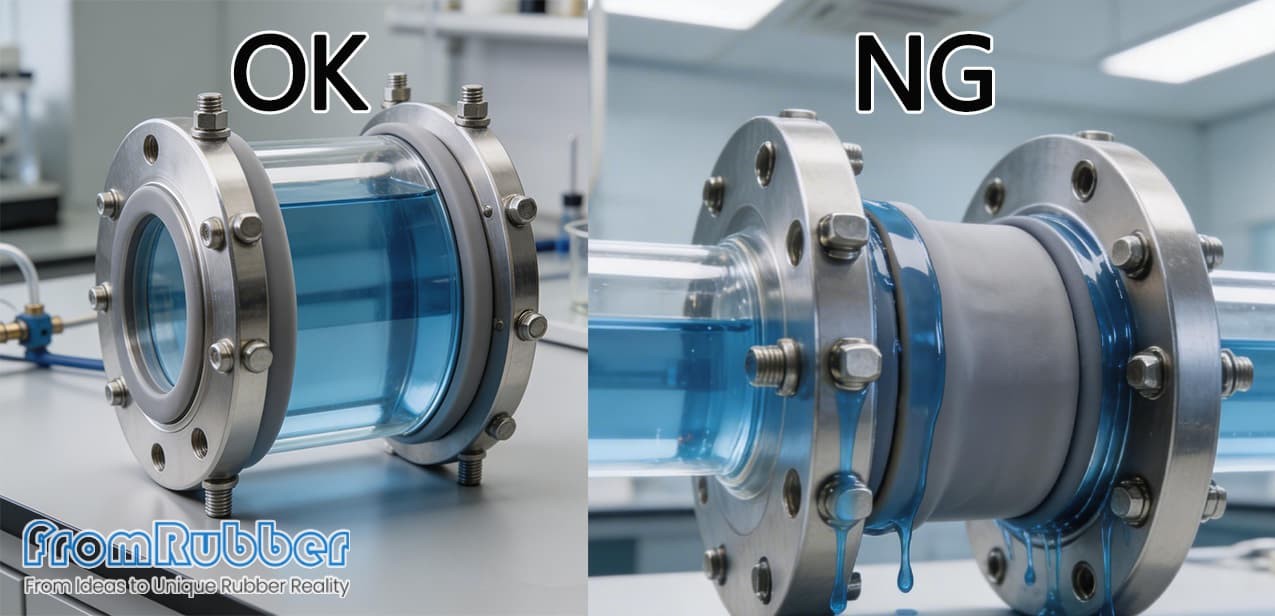
- Standard VMQ in ASTM #1 oil: +45% volume change, hardness drop of 25 points – complete seal failure.
- FVMQ from Fromrubber in same conditions: +8% volume change, hardness change -5 points – functional after 1,000h.
- In diesel fuel at 60°C: VMQ disintegrated within 48 hours; FVMQ survived 500+ hours with moderate swell.
| Property after 168h/150°C in IRM 903 | Standard VMQ | Fromrubber FVMQ |
|---|---|---|
| Volume change (%) | +95% | +12% |
| Tensile retention (%) | 32% | 89% |
| Elongation retention (%) | 28% | 85% |
4. When Can Standard Silicone Be Used?
Despite its poor oil resistance, standard silicone remains the material of choice in many applications. At Fromrubber, we guide customers to use VMQ when:
Dry environments, air sealing, UV-exposed outdoor applications.
If oil contact is infrequent and low temperature, standard VMQ may survive with proper design.
When the priority is 250°C+ continuous heat with zero hydrocarbons present.
5. Fromrubber's Engineered Solutions
Custom Compounding for Oil Resistance
At Fromrubber, we don't just sell standard products – we engineer solutions. Our R&D team develops custom silicone formulations that balance oil resistance with other properties:
- High-fluorine FVMQ for maximum fuel resistance
- Blended VMQ/FKM for cost-effective oil protection
- Surface-coated silicone to delay oil penetration
- Low-swell grades for specific fluid families (e.g., synthetic oils)
We've helped automotive suppliers, marine equipment manufacturers, and industrial clients solve chronic oil-swelling failures. Fromrubber provides full material data sheets and prototype testing before volume production.
6. Alternatives to Silicone for Oil-Rich Environments
When oil resistance is paramount, sometimes silicone (even FVMQ) isn't the optimal choice. Fromrubber offers a full range of elastomers. Use this guide:
| Material | Oil Resistance | Temp Range | Best For |
|---|---|---|---|
| FKM (Viton®) | Excellent – minimal swell | -20°C to 200°C | Aggressive fuels, chemicals |
| HNBR | Very good | -30°C to 150°C | Dynamic oil seals, automotive |
| FVMQ (Fromrubber) | Good (for silicone family) | -60°C to 200°C | Low-temp + occasional oil |
7. Testing Your Application with Fromrubber
The only way to be certain is to test under real conditions. Fromrubber offers a free preliminary material selection service. Send us your fluid type, temperature range, pressure, and duty cycle. We'll recommend the optimal silicone grade – standard, fluorosilicone, or an alternative elastomer – and provide sample coupons for immersion testing.
Need Oil-Resistant Seals?
Contact Fromrubber today for custom silicone gaskets that won't swell and fail.
In summary: Standard silicone rubber gaskets are not resistant to oils and fuels – they will swell, soften, and fail. However, Fromrubber offers fluorosilicone (FVMQ) and custom compounds that bridge the gap, providing moderate oil resistance while retaining silicone's thermal and UV advantages. For heavy oil exposure, FKM or HNBR may be recommended. With over 20 years of silicone molding expertise, Fromrubber helps clients worldwide select or develop the perfect material for every fluid contact scenario. Contact our engineers to discuss your application – we'll ensure your gaskets perform, not perish.