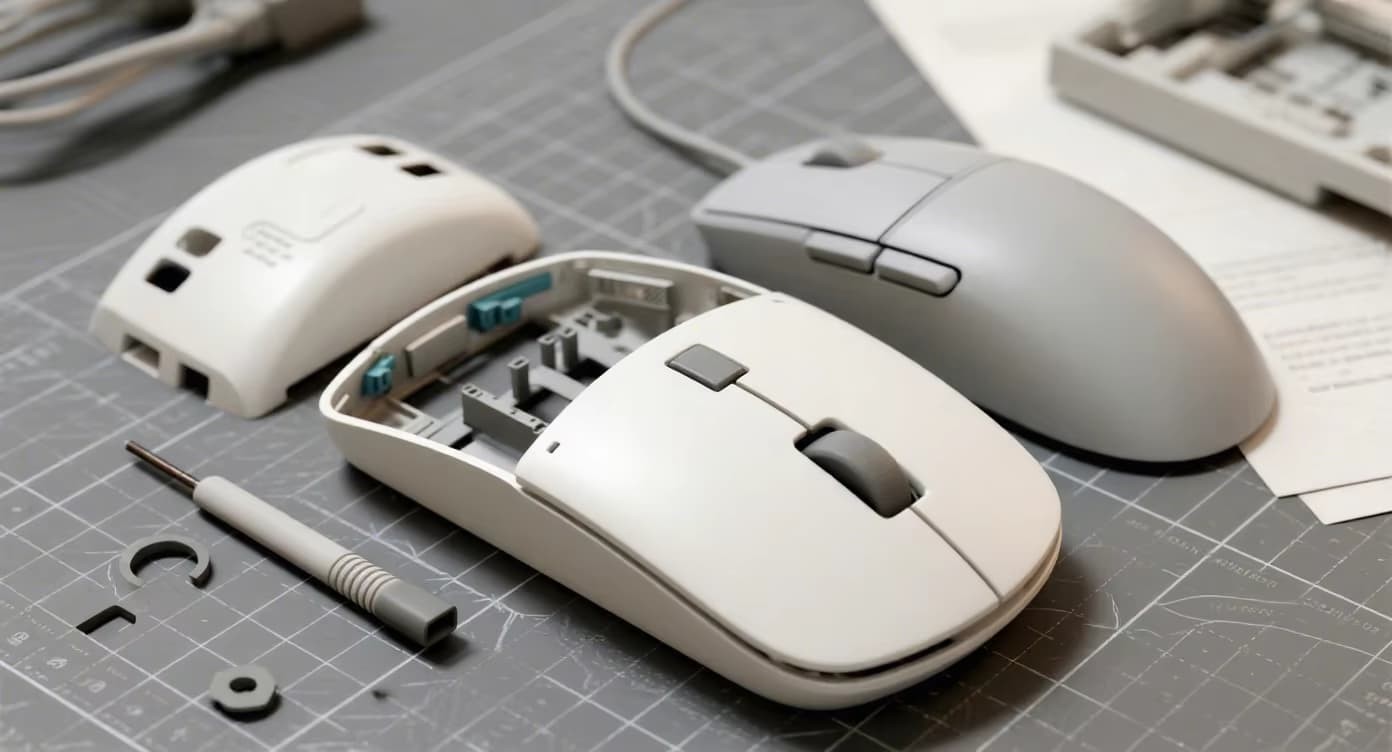
Product designers often wonder whether a single injection mold can produce both glossy and matte mouse plastic parts. The answer is yes — with the right approach. At FromRubber, we have developed multiple methods to achieve different surface finishes from the same mold base. This guide explains how interchangeable inserts, secondary texturing, and specialized molding techniques allow you to produce both glossy and matte mouse components without investing in duplicate tooling.
Yes
One mold can produce both finishes
Three proven methods:
- Interchangeable cavity inserts
- Selective texturing on same cavity
- Mold surface modification (post-polishing or EDM)
Why the same mold can produce different finishes— Glossy and Matte Mouse Plastic Parts
The surface finish of an injection molded part is a direct replica of the mold cavity surface. If the mold cavity is polished to a mirror finish, the plastic part will be glossy. If the cavity is textured via EDM or chemical etching, the part will be matte. Therefore, the question becomes: can a single mold have both glossy and matte cavity surfaces, or be modified to switch between them? The answer is yes through several engineering approaches that FromRubber routinely deploys.
Key insight: The plastic does not know the difference — it simply copies whatever surface the mold provides. This means flexibility is built into the tool, not the material.
Method 1: Interchangeable cavity inserts
The most common and reliable method for producing both glossy and matte mouse parts from the same mold base is using interchangeable cavity inserts. The mold is designed with removable steel blocks that form the visible surfaces of the mouse shell. One set of inserts is polished to SPI-A1 or A2 glossy finish. Another set is EDM-textured to VDI 21, 27, or 33 matte finish.
When a production run requires glossy parts, the glossy inserts are installed. For matte parts, the matte inserts replace them. The mold base, ejection system, cooling channels, and runner system remain identical. Changeover time is typically 30 to 60 minutes.
Advantages: Perfect finish quality on each insert type. No compromise between glossy and matte. Each insert set can be optimized independently.
Disadvantages: Higher initial tooling cost (two sets of inserts). Requires storage space for spare inserts.
Insert swap time
30-60 min
Glossy ↔ Matte
Method 2: Selective texturing on the same cavity
Some mouse designs intentionally combine glossy and matte surfaces on the same part. For example, a glossy top dome with matte side grips. This is achieved through selective texturing — different areas of the same cavity are finished differently. The main visible area receives high polishing, while grip areas are masked during EDM or chemical etching.
FromRubber technique: We apply laser-resistant tape over glossy zones before the cavity undergoes chemical etching. The tape blocks the etching solution, leaving those areas polished. After etching, the tape is removed, revealing a single cavity with both glossy and matte zones. This produces mouse parts with seamless transitions between finish types.
This method does not allow switching between all-glossy and all-matte parts — it produces hybrid finishes only. However, for products that require both finish types on the same component, this is the most efficient solution.
Method 3: Mold surface modification (post-polishing or re-texturing)
For manufacturers who need to produce glossy parts for one product generation and later switch to matte for a refresh or different model, the mold cavity itself can be modified. Starting with a polished (glossy) cavity, the mold can be sent for EDM texturing to convert it to matte. However, this is a permanent change — converting matte back to glossy requires re-polishing, which removes steel and may alter part dimensions.
Glossy → Matte
Feasible via EDM texturing. Steel removal: 0.01-0.03mm. Part dimensions slightly affected.
Matte → Glossy
Difficult. Requires polishing down below texture depth. Steel removal: 0.03-0.08mm. Part geometry may change.
Recommendation
Use interchangeable inserts if switching between finishes is planned. Avoid permanent cavity modification.
Comparison of methods for glossy and matte mouse plastic parts
| Criteria |
Interchangeable inserts |
Selective texturing |
Permanent modification |
| Initial tooling cost | Higher (2 insert sets) | Medium | Lowest (one finish only) |
| Switch time | 30-60 minutes | Not applicable (hybrid only) | Days (rework required) |
| Finish quality | Excellent on both | Very good | Good for final finish only |
| Reversible? | Yes (swap inserts) | Yes (new cavity) | No |
| Best application | Alternating production runs | Hybrid finish on one part | One-time finish change |
Real case: Gaming mouse with two finish variants
A gaming peripheral brand wanted to launch two versions of the same mouse: a budget edition with matte finish and a premium edition with high-gloss. FromRubber designed a single mold base with interchangeable cavity inserts. The glossy inserts received SPI-A2 polishing (mirror finish). The matte inserts received VDI 24 texture (fine matte). Results:
- Tooling cost: 35 percent less than two complete molds
- Insert changeover time: 45 minutes between finish types
- Production flexibility: Run 10,000 glossy, switch to matte, run 25,000 matte, switch back
- No compromise on finish quality for either variant
Limitations and considerations
Material compatibility
Some materials (e.g., glass-filled nylon) cannot achieve high-gloss finishes regardless of mold polish. ABS and PC/ABS are best for glossy.
Shrinkage differences
Matte surfaces may have slightly different ejection behavior. Cooling channel design must accommodate both insert sets.
Cost threshold
Interchangeable inserts are economical when producing over 15,000 parts per finish type annually. Below that, two separate molds may be simpler.
FromRubber expertise: flexible finish solutions
With over 400 mouse enclosure projects completed, FromRubber specializes in designing molds that accommodate multiple surface finishes. We offer:
- Interchangeable insert design with quick-change locking mechanisms
- SPI polishing from A1 (mirror) to B1 (semi-gloss)
- VDI texturing from fine 12 to coarse 33, plus custom chemical etching patterns
- Selective texturing for hybrid glossy-matte parts on the same surface
- Laser texturing for logos and micro-patterns
Our engineers will recommend the most cost-effective approach based on your annual volumes, finish-switching frequency, and target aesthetic.
FromRubber — Injection molds for glossy, matte, and hybrid mouse parts. Flexible tooling solutions for your finish variants.