
How to design a custom silicone rubber control panel with backlighting?
How to Design a Custom Silicone Rubber Control Panel With Backlighting?
Detailed Explanation: The Engineering of a Backlit Silicone Control Panel
Designing a backlit silicone rubber control panel is fundamentally an optical problem layered onto a mechanical sealing problem. Silicone rubber is naturally translucent — pigmented grades transmit 5–30% of incident light depending on color, wall thickness, and filler loading — but it is not transparent. To turn that partial opacity into crisp, even illumination, the four optical layers (light source, distribution system, keypad body, surface coating) must be designed as one integrated system. Treating any layer in isolation typically produces one of three failure modes: dark legends on the far edge, glowing halos around the webbing, or hot spots directly over each LED.
Step 1 — Light source selection. Three technologies dominate in 2026:
- LED + Light Guide Film (LGF): The standard professional solution. Edge-mounted SMD LEDs (0603/0805, 50–300 mcd each) feed a 0.3–0.6 mm polycarbonate or acrylic light guide film whose underside dot pattern scatters light upward. Uniformity 75–90%, optical efficiency 60–80%, 2–4 LEDs per keypad. This is the right default for any keypad with more than 4 keys.
- Direct SMD LED per key: Higher brightness and per-key control, used in gaming peripherals, premium automotive interiors, and status-indicator applications. Hot spots are mitigated with a diffusion layer or secondary translucent silicone coating. Power and thermal budgets grow quickly with key count.
- Electroluminescent (EL) panels: Cool uniform glow over the entire panel (30–60 cd/m², about 1/10 of LED output), 0.2–0.5 mm thin, but limited color (typically cyan/green), and the inverter makes a faint whine that is unacceptable in medical quiet-zone devices.
Step 2 — Translucent silicone formulation. Light transmission and diffusion are inversely related — the art is finding the balance your application needs. Typical engineered parameters: transmission 60–75%, haze 50–80%, wall thickness optimized to 1.2–1.8 mm. Adding diffusion additives (silica microspheres, titanium dioxide, fine pigments) shifts the optical profile without losing mechanical strength. FromRubber compounds translucent silicone in-house to tune transmission and hardness simultaneously.
Step 3 — Legend finishing. For backlit panels the industry gold standard is laser etching: spray a translucent white keypad with an opaque topcoat (typically black or dark gray), then ablate the legend shape with a precision laser to reveal the white substrate underneath. When backlit, the legend glows uniformly; when unlit, it reads as clean matte white. Because the legend is carved into the coating rather than printed on top, it cannot wear off — verified across automotive and medical deployments exceeding 1 million actuations.
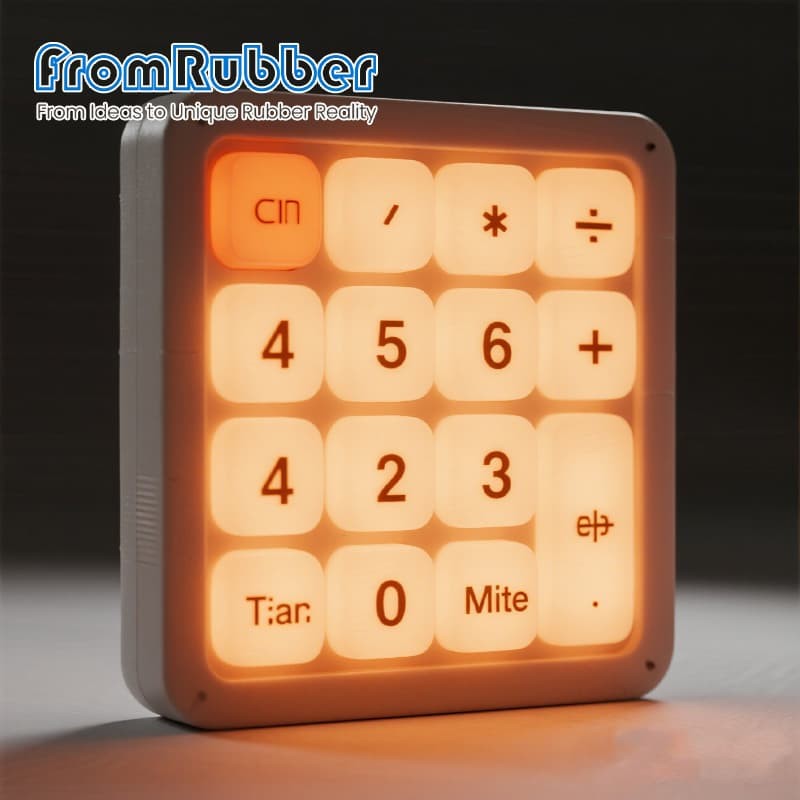 A backlit silicone keypad shows the clean uniform luminance achievable when translucent silicone, light guide film, and laser-etched legends are engineered as one optical system.
Step 4 — Mechanical sealing. The light source, LGF, and silicone overlay are typically bonded to a rigid PCB/PMMA backplate using 3M 467/468 transfer adhesive, then overmolded into a sealed gasket groove to achieve IP65–IP67. Where IP68 is required (medical wash-down, outdoor industrial), a one-piece molded silicone body with integral gasket replaces the adhesive bond.
Step 5 — Electrical and optical verification. Every design should undergo (a) luminance measurement with a calibrated imaging photometer (target ≥80 cd/m² for daylight-readable panels, ≥30 cd/m² for low-light indoor), (b) uniformity ratio (target ≥0.7), (c) color point check against the product specification, and (d) a 168-hour humidity/thermal cycle to validate LED-to-silicone interface integrity.
Case Study: Handheld Diagnostic Device Control Panel
A handheld point-of-care diagnostic device for ICU bedside use needed a control panel that was readable in a darkened patient room under headlamp illumination and glove-friendly to operate. The medical OEM engaged FromRubber to redesign their membrane-switch panel as a backlit silicone control panel.
- Stack-up: Translucent white silicone overlay (Shore A 55 ± 5), laser-etched black topcoat with white legends, 3M 467 adhesive bond, 0.5 mm polycarbonate LGF, 4× 0805 white SMD LEDs at the LGF edges, FR-4 PCB.
- Optical result: Luminance 95 cd/m² center, 78 cd/m² corner, uniformity ratio 0.82, color temperature 6500 K ± 200 K. Power draw 28 mA at 5 V.
- Mechanical result: IP67 sealed after one-piece overmold, 1.2 million actuations on every key with no legend wear, no LED color shift, no loss of sealing under 1.5 m drop tests.
- Outcome: The OEM consolidated three previous supplier assemblies into one piece, cut assembly time by 22%, and gained FDA 510(k) clearance in 4 months by reusing FromRubber's biocompatibility test data.
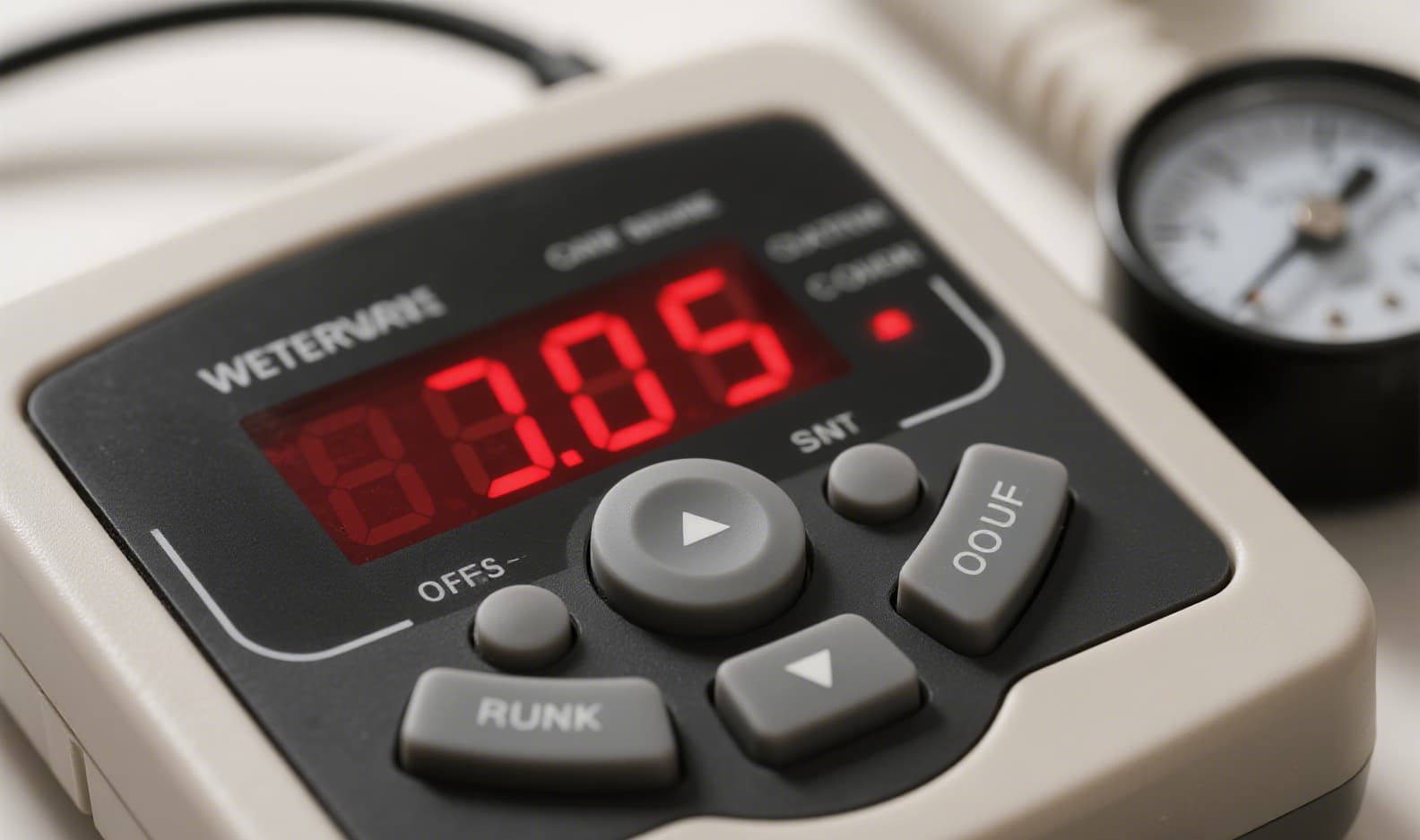 Industrial instruments such as multimeters often rely on backlit silicone keypads with discrete legend illumination for legibility in low-light service environments.
Data: Backlight Method Comparison for Silicone Control Panels
| Method | Uniformity | Brightness | Adds Thickness | Relative Cost | LED Life | Best For |
|---|---|---|---|---|---|---|
| LED + LGF | Excellent (75–90%) | High (60–120 cd/m²) | 0.4–0.8 mm | $$ | 50,000–100,000 h | Most consumer/industrial panels |
| Direct SMD LED per key | Good (with diffuser) | Very high (up to 200 cd/m²) | Minimal | $$$ | 50,000–100,000 h | Selective key highlight / status indication |
| EL panel | Perfect | Low-medium (30–60 cd/m²) | 0.3–0.5 mm + inverter | $$ | 3,000–8,000 h | Even glow, power-sensitive |
| Fiber optic | Good | Medium | 1.0–2.0 mm | $$$$ | 50,000+ h | EMI-sensitive, military/medical |
FromRubber routinely prototypes in all four technologies; the choice typically hinges on luminance target, power budget, sealing requirement, and total cost target rather than on optical capability alone.
Related Questions
Can silicone keypads be backlit, and what are the common methods?
A primer on the four backlighting technologies and how each matches a product category.
Laser Etching vs. Silk Screen Printing for POS keypads
Why laser-etched legends are the standard for backlit keypads that must survive heavy use.
How to integrate LED backlighting into silicone control panels
Step-by-step assembly and alignment procedure from FromRubber's production engineers.