
Mining Equipment Silicone Panel Buttons: Why Do Some Keys Feel Harder Than Others?
When operators say some keys on a machine panel feel harder than others, they are usually describing a real difference - not a preference. The awkward part is that the difference rarely comes from one place. On the same moulding, a button near a corner can need noticeably more force than one in the middle, and two buttons that look identical on the drawing can return at different speeds. Tactile inconsistency is a stack-up problem: panel pressure, button geometry, moulding variation and position on the keypad all push the same button in different directions.
The four patterns operators report, and what each one hints at
- One or two keys need more force. Usually a local geometric or compression difference, not the whole keypad.
- Return speed differs between keys. Return geometry and local preload, rather than the pressing force itself.
- Centre keys and edge keys feel different. A structural effect of how the keypad is supported and clamped.
- Identical-looking keys feel different. Dimensional or hardness variation inside the same moulding.
Sorting the complaint into one of these four patterns before measuring anything removes most of the guesswork.
Start with installation, and leave the compound alone
The instinct when tactile force varies is to change the silicone compound. That step should come last, because installation produces the same symptoms and costs nothing to check.
Five installation conditions change the force an operator feels:
- Uneven panel pressure. A cover that closes flat at one end and bows at the other compresses part of the keypad more than the rest.
- Keypad misalignment. A shifted keypad puts some caps closer to the opening wall, which adds friction without changing the design.
- Housing deformation. Cast or moulded covers move when they are fastened, and the movement is not uniform.
- Tightening sequence. Sequential torque around a perimeter pulls the panel into a slight spiral that a cross pattern avoids.
- Local compression. A boss, a rib or a connector shell standing slightly proud loads one cluster of buttons.
A quick, repeatable test: press every button with the panel open and no fasteners, then again with fasteners at production torque. The buttons whose feel changes between the two states are not geometry problems - they are clamping problems, and they belong to the enclosure design.
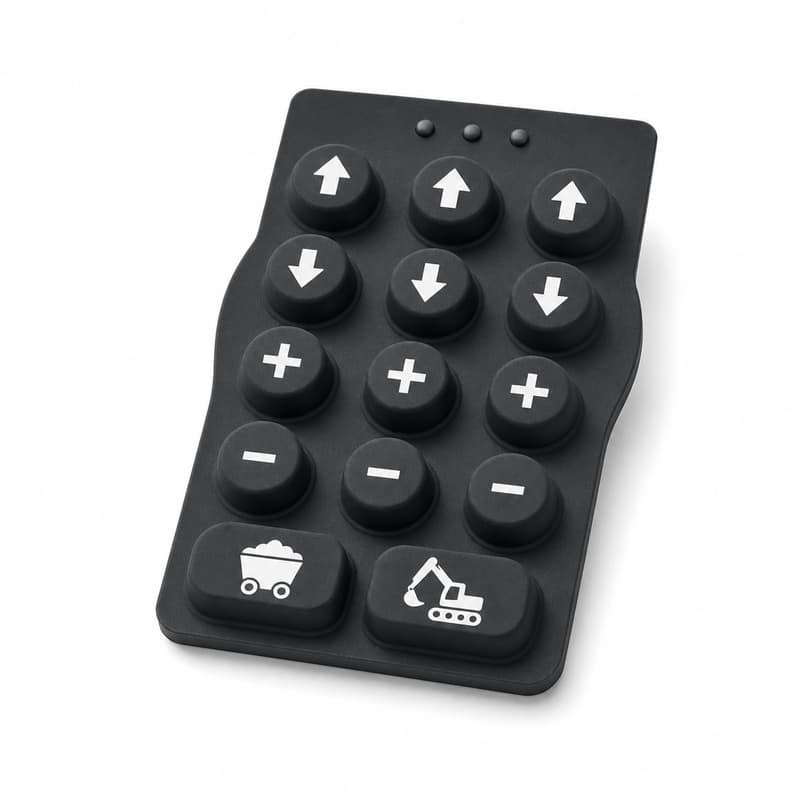
Button geometry sets the force curve, and it varies across a panel
Actuation force in a silicone keypad is produced by deflecting a web, so the force curve is a geometric result. Six features move it, and none of them is constant across a panel:
- Button height. Taller caps sit nearer the panel opening and change how much of the stroke is available before contact.
- Wall thickness. A thicker wall resists the finger, and it does so more noticeably on small caps than on large ones.
- Return geometry. The form of the web decides whether the force rises smoothly or steps, and whether the return is crisp.
- Key diameter and shape. A wide button spreads the same web force over a larger area, so it feels lighter per unit of finger travel.
- Supporting structure. Material shared between neighbouring buttons stiffens both of them.
- Travel distance. More travel means more deflection at the bottom of the stroke and a different force at the switching point.
The important consequence is that geometry differences do not have to be large to be felt. A change of a few hundredths of a millimetre in web thickness can move the force curve enough for a trained operator to notice, which is why the requirement has to be written as a range with a named test method rather than as a single target. The relationship between force, travel and what an operator perceives is examined in this discussion of selecting the right tactile force for control panel silicone buttons.
Hardness consistency: useful, but not the whole story
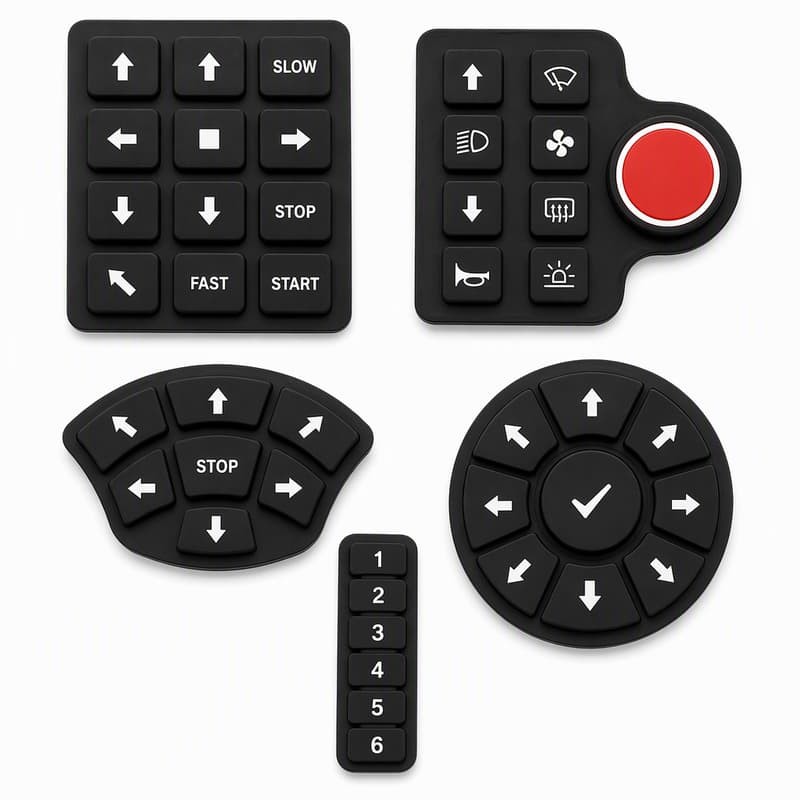
Silicone hardness is measured as an indentation value, and the reference methods are ISO 48-4:2018 for durometer (Shore) hardness and the equivalent IRHD approach. It is a genuine specification, and it is genuinely useful - but it does not determine button force on its own.
Two keypads moulded from the same nominal hardness can feel different, because the force comes from the web geometry the material is deflecting inside. A softer compound in a thick web can be stiffer than a harder compound in a thin one. That is why "use a softer silicone" is not a reliable fix for uneven feel across a panel: it moves the whole panel, and the buttons that were already inconsistent stay inconsistent relative to each other.
Where hardness consistency does matter is across a production run. If the compound varies between batches, or the cure condition drifts, the same moulding produces a different force curve. The useful control is to state a hardness range with a measurement method, and to ask for that value to be recorded per batch. Tightening the force tolerance without controlling hardness is usually wasted effort, and this explanation of actuation force tolerance across batches sets out why the two have to be quoted together.
Position on the keypad changes what the finger feels
Two buttons with identical geometry on the same sheet do not necessarily behave identically, because the material around them is not identical.
- Edge buttons. Less surrounding material, so the local stiffness is lower and the button can deflect more easily - but it is also closer to the clamped frame, which can add friction at the opening.
- Corner buttons. Two free edges and two stiff boundaries. The combination often produces the widest force spread on a panel.
- Large buttons. More membrane area means a softer initial feel and a different force rise toward the bottom of the stroke.
- Closely spaced buttons. Shared webs couple neighbours: pressing one slightly deflects the material that carries the next.
Where a panel mixes all four, demanding one force value for every button is unrealistic. Group the buttons by function and state a range per group: a jog key pressed thousands of times per shift and a configuration key pressed twice a year do not need the same tactile signature, and treating them as identical is a common reason a "tactile consistency" complaint never closes. The geometry side of this is covered in this analysis of dome height tolerance and inconsistent button response.
Position also changes the duty the compound sees. A button in the middle of a cluster is pressed at an angle that is more or less consistent, while an edge button is often pressed from outside the panel, at an angle, with a glove. The force the operator reports is not the same quantity as the force a gauge measures on a test fixture, and that difference is largest where access is worst.
This is why a tactile specification should name the measurement position and the actuator used for the test. A value recorded with a flat probe on the button centre is a different number from what a gloved thumb produces at the panel edge, and both are legitimate - they simply answer different questions.
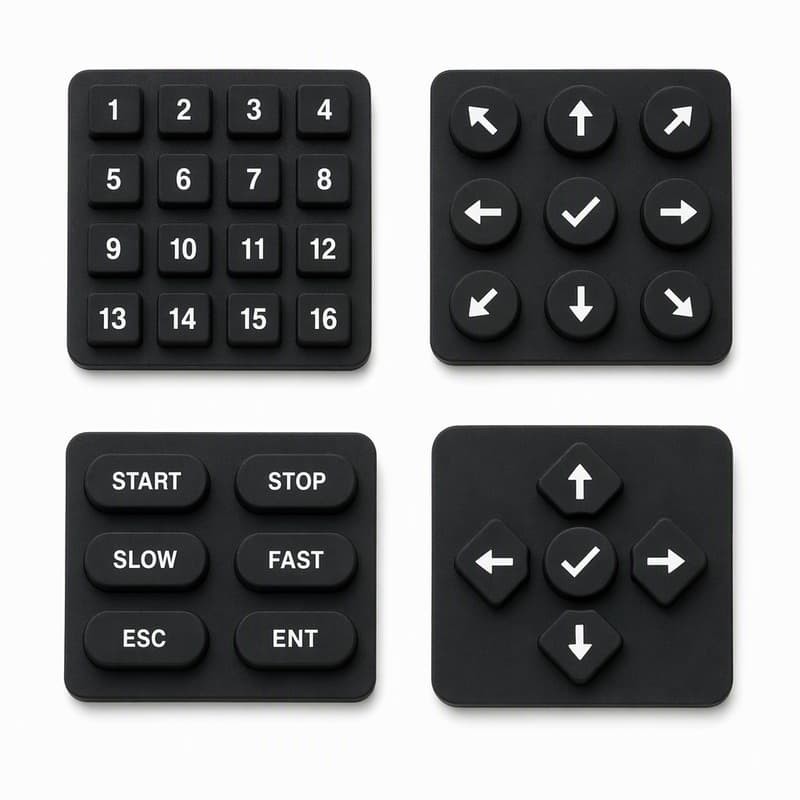
Mould and dimensional consistency across a production run
Once installation and geometry are eliminated, the remaining variation comes from the tool and the process. Five sources are worth asking about explicitly:
| Source | What it changes | Why it shows up as uneven feel |
|---|---|---|
| Cavity-to-cavity variation | Web thickness and key height | Parts from different cavities behave differently on the same panel |
| Flash | Clearance at the cap and the frame | Thin flash adds friction at the opening without a visible defect |
| Local thickness variation | Web stiffness | A slightly thicker web raises the force on that button only |
| Key geometry variation | Force curve shape | Small shifts change where the force rises in the stroke |
| Cure and moulding drift | Hardness and compression behaviour | The same tool produces a different force curve on a later run |
None of these is exotic, and all of them are visible with a sample cut through the keypad and a dimensional report rather than with a discussion. Compression set belongs in the same conversation, because a web that takes a set early will read as a force change on a machine that has been in service rather than on one just built. Compression set is defined and measured under ISO 815-1:2019.
Panel and board alignment as a contributor to feel
External components can change perceived force even when the keypad is correct. If the board sits slightly high, the web is deflected further at rest and every button feels heavier. If the panel opening is off centre, some caps rub and others do not. If the housing is not flat, the buttons nearest the fastening points load first.
This is a useful place to mention a standard that panel builders already work to: IEC 60947-5-1:2016 covers electromechanical control circuit devices and switching elements, including the push buttons and indicator lights used on machine panels. It governs the device, not the silicone keypad, and it is worth being explicit about that boundary - a keypad cannot be qualified against a switchgear standard, but the panel the keypad is fitted into usually has to meet one, which is why mounting dimensions and accessibility requirements travel back into the keypad drawing.
How to write a tactile requirement a mould shop can hold
Most unresolved tactile complaints trace back to a requirement that was never written down in measurable terms. A specification that can actually be held contains seven items:
- Required operating force as a range, per button group, with the deflection at which it is measured.
- Key travel from rest to a defined end point, not "similar to the sample".
- Silicone hardness range with the measurement method named.
- Button geometry including wall thickness and web dimensions, not only the outer profile.
- Dimensional tolerance per feature, referenced in the same coordinate system as the housing.
- Operating temperature range, since it changes how the compound behaves in service.
- Expected cycle life where the button duty justifies it, together with the test that demonstrates it.
FromRubber, the brand of Dongguan Bohao Electronic Technology Co., Ltd., has moulded custom silicone keypads since 2010 and reviews force, travel and geometry together at the drawing stage, because those three only have meaning as a set.
Frequently asked questions
Why do silicone buttons on the same keypad feel different?
Because the material around each button is different. Edge and corner buttons have less surrounding rubber, shared webs couple neighbouring keys, and small moulding variations change the web thickness that produces the force.
Does silicone hardness determine button force?
Not on its own. Force comes from deflecting the web geometry, so hardness and geometry have to be specified together. Hardness consistency matters more across batches than as a single nominal value.
Can panel deformation change button feel?
Yes. A cover that bows when it is fastened applies more compression at one end, which raises the pressing force and reduces free travel on the buttons nearest that load.
Can mould variation cause inconsistent keypad force?
It can. Cavity-to-cavity differences, flash and local thickness variation all change the force curve, which is why a dimensional report across cavities is more useful than a single good sample.
How can a keypad be made to feel more consistent?
Group buttons by required force range rather than asking for one value, control web thickness and hardness as a pair, and agree the measurement method and deflection before the tool is cut.
In short
Uneven tactile force on a machine panel is usually a combination of clamping, geometry and moulding variation, not a single material fault. Check installation first, then group the buttons by function, then write the force, travel and hardness requirements as ranges with named measurement methods. Done in that order, the inconsistency narrows to a few buttons instead of the whole panel.
Sources and standards referenced
- ISO 48-4:2018, Rubber, vulcanized or thermoplastic - Determination of hardness - Part 4: Indentation hardness by durometer method (Shore hardness). https://..........org/standard/74969.html
- ISO 815-1:2019, Rubber, vulcanized or thermoplastic - Determination of compression set - Part 1: At ambient or elevated temperatures. https://..........org/standard/74943.html
- IEC 60947-5-1:2016, Low-voltage switchgear and controlgear - Part 5-1: Control circuit devices and switching elements - Electromechanical control circuit devices. https://..........org/certification/iec-standards/iec-60947-5-12016
Contact
FromRubber - Dongguan Bohao Electronic Technology Co., Ltd., custom silicone keypad manufacturer since 2010. Email: nani..........com or karl..........com. WeChat and WhatsApp: +86 18676210913. Website: ..........com