
Why Does a Silicone Patch Peel Off After Washing on Polyester Fabric?
Most silicone patch peeling on polyester is a bond-line problem, not a patch defect. The adhesive never fully wet the fibre, so the patch was only partly attached before it reached the first wash. You can confirm that in one look: if the adhesive layer travels away with the patch and the fabric underneath is clean, the bond was under-formed. If the residue stays on the fabric, the patch construction is the suspect rather than the press.
Below is the short path through the three things that actually decide the result: substrate, bond formation, and the wash cycle you are testing against.
Read the peel surface before changing anything
| What you see | Where the failure is | What it usually means |
|---|---|---|
| Fabric clean, adhesive travels with the patch | Adhesive to fibre interface | Under-formed bond: temperature, dwell time or a fabric finish |
| Adhesive stays on the fabric, silicone lifts | Silicone to adhesive interface | Backing system not matched, or bond line contaminated |
| Adhesive torn, residue on both surfaces | Inside the adhesive layer | Bond formed, then fatigued by washing, drying heat or stretch |
| Patch intact, fibres pulled out of the fabric | The fabric itself | Bond is stronger than the substrate |
Photograph both surfaces at the same magnification every time you run this check. A photographed baseline is what lets you compare one season against the next instead of arguing from memory.
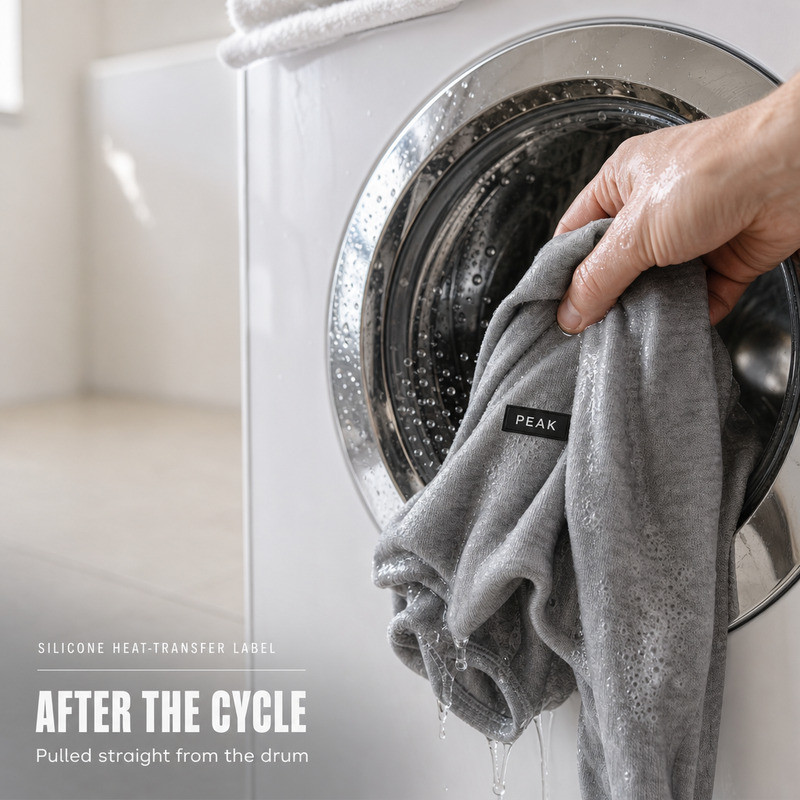
The wash cycle loads the patch perimeter far more than the patch centre.
Why polyester is the difficult substrate
Polyester is hydrophobic and comparatively smooth, which is exactly why it is popular in sportswear. Published work on PET fibre modification states the same problem from the finishing side: the low hydrophilicity of PET fabrics causes difficulties in finishing and, in the authors' words, low adhesion to plastics and rubber. That is a material-level handicap, and a hotter press does not remove it.
Surface energy decides how well a molten adhesive wets the fibre. No wetting means no bond, however long the platen stays down. This is also why fabric finishes matter: softeners and water-repellent treatments are designed to change the fibre surface, and some of them reduce surface energy, which is the opposite of what a heat-transfer bond needs.
Test it in one afternoon. Press identical patches onto grey goods and onto finished, softened fabric, then wash both. If grey goods survive and the finished fabric fails, the finish is your variable.
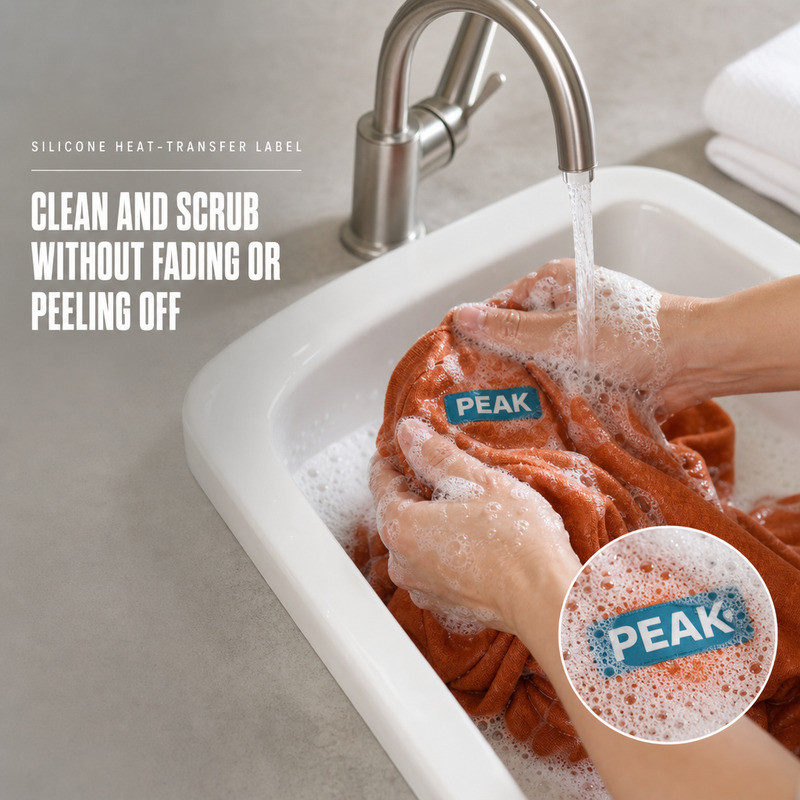
Repeated wetting and squeezing works detergent into any gap at the perimeter.
How long should the carrier film stay on before it is peeled?
The first clock is dwell time under load, the one everybody writes down. The second is cooling time before the carrier film comes off, and it is where a lot of peeling starts. A heat-transfer adhesive does not reach full strength while it is still hot. Strip the film warm and the adhesive is drawn toward the film instead of being held by the fibre, which pre-loads the interface before the garment is even folded.
Peer-published application data makes both clocks explicit, and it is worth noting that the published numbers do not agree with each other. That disagreement is the practical lesson.
| Peer-published parameter | Manufacturer A (Dongguan) | Manufacturer B |
|---|---|---|
| Press temperature | 155 to 160 °C | 150 to 160 °C, up to 170 maximum |
| Pressure | 2 to 4 kg | 4 kg, raised to 4.5 kg if needed |
| Dwell time | 15 to 20 seconds | 25 to 30 seconds |
| Film removal | Cold peel; lay flat 15 minutes to reach ambient temperature before peeling | Cold peel after the patch cools completely |
| Waiting time before washing | Minimum 24 hours | At least 48 hours |
Two experienced manufacturers publish dwell times that differ by ten seconds and waiting times that differ by a full day. That is not an error; it reflects different adhesive systems and different reference fabrics. It is the reason a supplier's sample data cannot be transferred straight onto your fabric, and the reason a cooling time that exists only in the operator's head is a production risk.
One more thermal point worth knowing: a standard silicone rubber datasheet typically quotes a service range of about -60 to +200 °C, and heat-resistance testing at 225 °C for 70 hours shows only a few points of hardness change. Drying heat is therefore rarely what damages the silicone. What it damages is the bond line and the edge geometry around it.
Which wash cycle should a silicone patch be tested against?
Domestic laundering procedures are standardised precisely because the parameters change the answer. ISO 6330:2021 defines reference machines, detergents and ballast loads together with a set of washing procedures and six drying procedures, and its own note states that using a different machine type, detergent or dryer type can affect the result. Two suppliers can both report a passing result and both be right, while your garment fails, because neither test reproduced your temperature, detergent, drum load or drying heat.
Colour-fastness laundering standards make the same point from another direction. ISO 105-C06:2010 describes single and multiple test cycles and notes that a multiple test may correspond to up to five domestic or commercial launderings at temperatures not exceeding 70 °C, with severity coming largely from increased mechanical action. Mechanical action, not chemistry, is often what finishes off a marginal patch bond.
For the patch itself, the closer analogue is a coated-fabric adhesion test. ISO 4637:1979 exists for a thin rubber layer bonded to fabric, where conventional peel methods are difficult, and it notes that a direct-tension result does not necessarily correlate with a peel test. A peel value and a tension value are not interchangeable numbers.
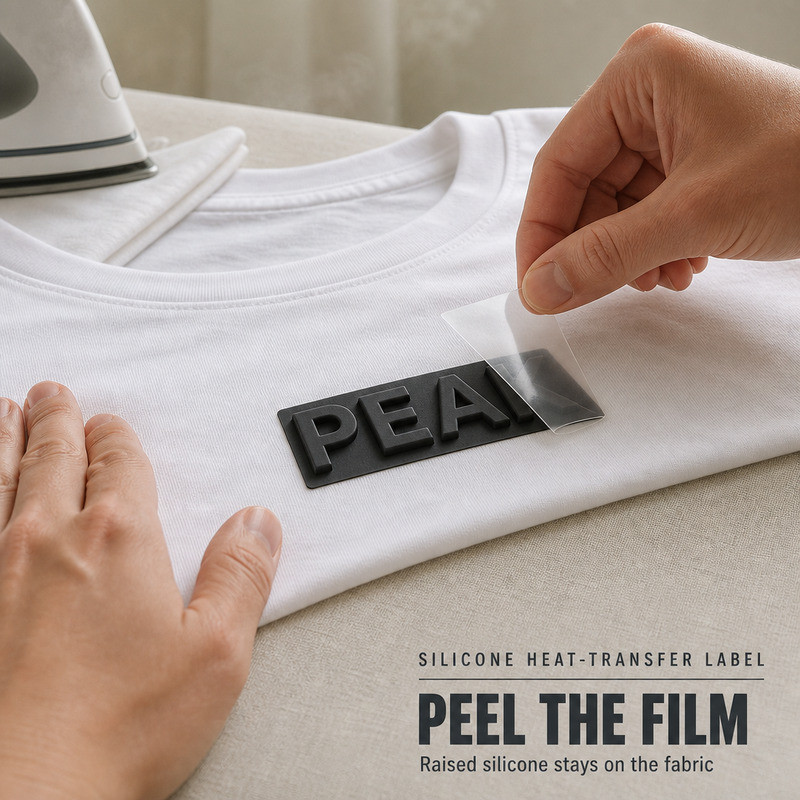
Carrier removal is a step in the bond, not a cleanup step after it.
Limits worth stating Silicone heat-transfer labels are not suitable for every laundry process. Peer application instructions exclude dry cleaning and chemical wash routes such as bleach, enzyme wash and stone wash, and warn against pressing or steaming directly on the transfer or scratching the edges with metal or fingernails. If your garment care label permits those routes, the patch specification has to be re-tested against them rather than assumed.
What to send a supplier before you order
- Fabric composition and construction, grey or finished goods
- Weight, thickness and stretch percentage in both directions
- Any coating, laminate or surface finish, and whether it can change between lots
- Garment position of the patch, and whether that area is flat or curved
- Patch dimensions and the smallest feature width in the logo
- Press temperature, dwell time and the cool-down time your line actually achieves
- Expected wash cycles, wash temperature, detergent type and drying method
A patch supplier can only match a backing system to your process if they know the process. Most bonding failures we see at sample stage trace back to one of those nine items never having been exchanged.
FromRubber is a custom silicone manufacturer in Dongguan, China: Dongguan Bohao Electronic Technology Co., Ltd., Jingcheng Road 122, Langxia Village, Qiaotou Town, Dongguan, Guangdong, China. The factory has operated since June 2010, runs 32 compression moulding machines across two sites, and holds IATF 16949:2016, ISO 9001:2015 and ISO 14001:2015 certification. Silicone labels and heat-transfer patches for apparel are one of our main custom lines.
If you have a peeling case, the peel-surface photographs plus the fabric details above are usually enough to say whether a construction change or a process change is worth testing first. Email nani..........com or karl..........com, or reach us on WeChat and WhatsApp at +86 18676210913.
Sources
- ISO 6330:2021, Textiles - Domestic washing and drying procedures for textile testing: https://..........org/standard/75934.html
- ISO 105-C06:2010, Textiles - Tests for colour fastness - Part C06: Colour fastness to domestic and commercial laundering: https://..........org/standard/51276.html
- ISO 4637:1979, Rubber-coated fabrics - Determination of rubber-to-fabric adhesion - Direct tension method: https://..........org/standard/10594.html
- Sustainable Alkaline Hydrolysis of Polyester Fabric at Low Temperature, 2022: https://pmc.ncbi.nlm.nih.gov/articles/PMC8876586/
- Modification of Surface Energy and Wetting of Textile Fibers, Ferrero and Periolatto, IntechOpen, 2015: https://..........com/chapters/48818
- Heat Transfer Product User Manual, HMJ Silicone Sticker, Dongguan (press and wash parameters, storage, wash-route exclusions): https://hmjsiliconesticker.com/wp-content/uploads/2024/02/HMJ-Silicone-Printing-Heat-Transfer-application-instruction.pdf
- Custom 3D Silicone Patches, Custom Patch Factory (press parameters, thickness, aftercare): https://..........com/product/patches/3d-silicone-patches
- Material Properties - Silicone Rubber, MEC (temperature range, hardness and heat-ageing data): https://mec-uk.co.uk/new-admin/uploads/pdf/Material%20Properties%20-%20Silicone%20Rubber.pdf