
Custom Backlit Silicone Keypad: Design, Materials & Manufacturing Guide
publisherkarl
time2025/02/20

- A custom backlit silicone keypad is an optical part with a mechanical job. Compound diffusion, wall thickness over the legend, mask geometry and LED placement decide whether the panel looks engineered or improvised.
Backlit interfaces / design guide - reviewed 11 November 2026
A custom backlit silicone keypad is an optical component with a mechanical job. Light has to reach the legend, stop at the mask, and arrive evenly across every key, while the same moulding still collapses under a finger at the force the product needs. Most backlit failures are optical rather than mechanical: bright keys next to dim ones, a halo around a legend, or a glowing seam the designer never saw in a render.
The good news is that all three are predictable. Light behaves consistently inside a moulded part, and the decisions that control it are few: material, wall thickness, mask design, and where the LED sits relative to the legend.
Definitions. A custom backlit silicone keypad is a moulded panel in which selected areas transmit light from LEDs beneath the pad. A light guide is the region of silicone, or a separate film, that distributes light from the LED to the legend. Masking is the opaque layer that prevents light leaking between keys. Light uniformity is the ratio between the brightest and dimmest legend on the same panel, and it is the number that decides whether a backlit panel looks engineered or improvised.
Design reference points
- Translucent silicone diffuses light rather than transmitting an image, so a thicker light path is brighter but less crisp.
- Two moulded colours per part is the practical limit; a mask is usually a second shot, a print or a laminated film.
- Uniformity is measured as a ratio between the brightest and dimmest legend, not judged by eye.
- The web under a lit legend is thinner than under an opaque one, which changes the force and has to be re-checked.
Translucent silicone is not clear silicone
Silicone for backlighting is formulated to diffuse light rather than to transmit an image. That diffusion is what makes a legend glow evenly instead of showing the LED as a bright dot. The cost is efficiency: a more diffusing compound needs a brighter LED or a thicker light path. Choosing the compound before the LED and the legend area are known is the usual reason a first sample is too dim.
The mask is a geometry problem
Where the mask sits, and how thick it is, decides whether light leaks sideways into a neighbouring key. A thin mask over a thick wall leaks; a thick mask over a thin wall blocks cleanly. This is why mask design and wall design are reviewed together, and why a mask added after the tool is cut often produces a halo rather than a fix.
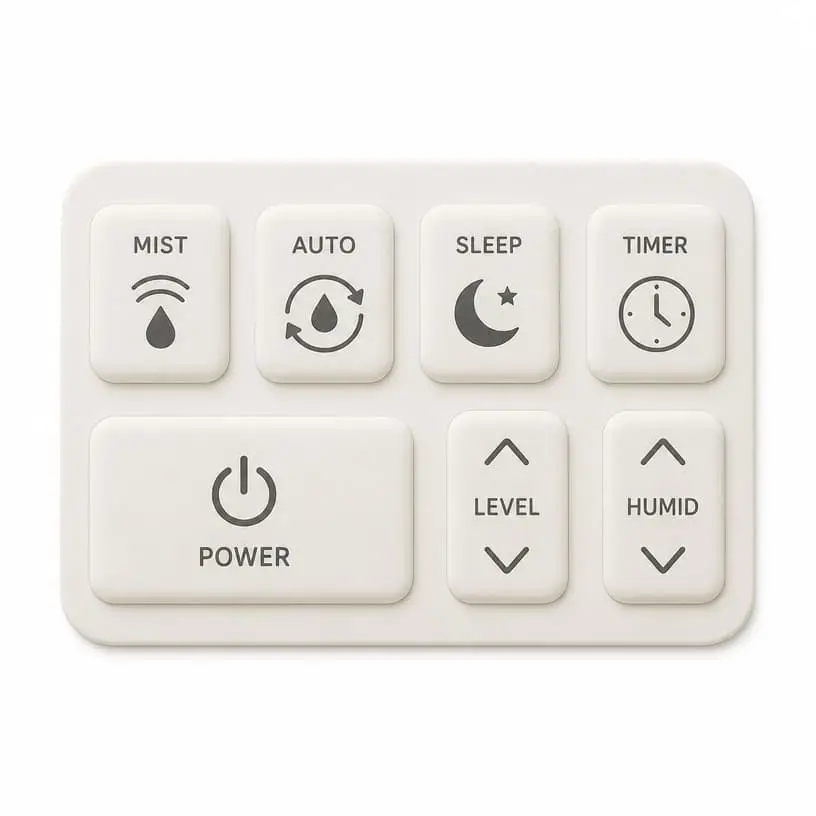
Four decisions that set the light
| Decision | Effect | Symptom when wrong |
|---|---|---|
| Compound diffusion | How evenly light spreads from the LED | A bright dot in the middle of a legend |
| Wall thickness over the legend | Brightness and crispness of the symbol | Blurry legend, or a legend too dim to read |
| Mask coverage and thickness | Light containment between keys | Halo around keys, or a glowing gap between them |
| LED position and count | Uniformity across the panel | One edge bright, the far edge weak |
Light guide or direct LED
Direct LED under every key
The simplest arrangement is one LED per illuminated key, usually on the PCB directly beneath it. It is bright, predictable and easy to debug, and it costs one component per key plus the driving circuit. On a small panel with six to eight keys and mains power, this is often the right answer.
A light guide for dense or battery-powered panels
Where the keys are close together, or where the power budget is tight, a light guide film spreads one or two LEDs across several legends. The trade is engineering effort for component count: the guide has to be modelled so the far end still lights, and the film adds thickness to the stack, which changes the travel of every key it passes under.
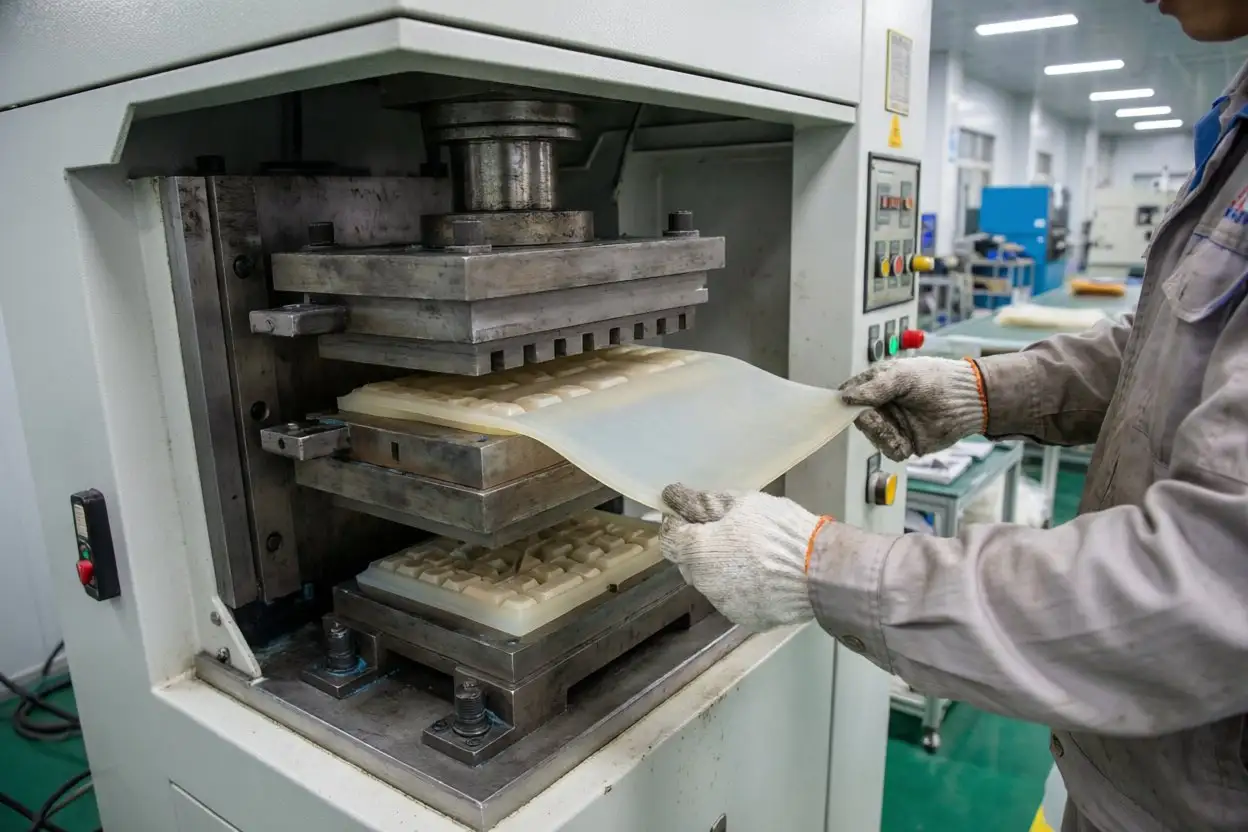
How a backlit silicone keypad is tooled
Three routes dominate. A two-shot moulding with translucent keys in an opaque base gives the cleanest masking and the highest tool cost. A single translucent moulding with a printed mask is cheaper and works well when the mask can be applied to a flat face. A translucent pad over a separate light guide film gives the most design freedom and the tallest stack, which matters when the housing is thin.
Each route changes the force, because the wall under the legend carries the press. A backlit key is usually thinner at the legend than an opaque key, which makes the web profile more critical rather than less. That is why the illumination decision should be taken before the web is drawn, not after the first sample comes back feeling soft.
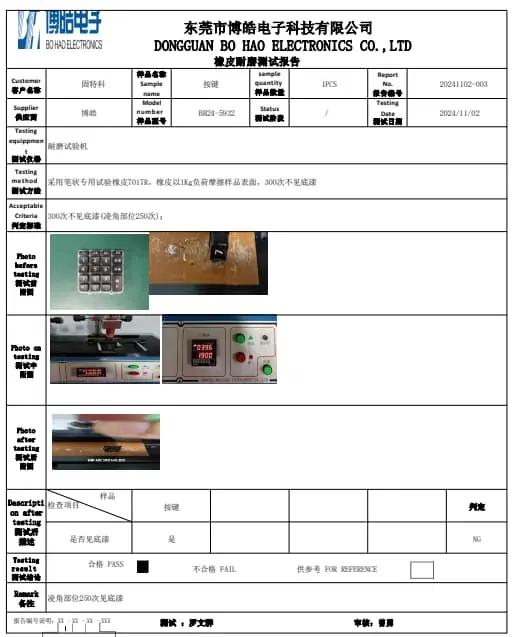
Testing a backlit panel before it ships
Three checks cover most of the risk. A dark-room photograph at fixed exposure establishes uniformity across the panel and gives a record for the limit sample. A legend abrasion test confirms that the print or coat over the lit area survives the cleaning routine. And a temperature check on the LEDs confirms that the housing does not cook a tightly packed array.
The abrasion report below is the kind of document a buyer should expect: a stated cycle count, a stated load, before and after photographs, and a pass or fail verdict with the test method named. Without the method, a durability claim cannot be reproduced.
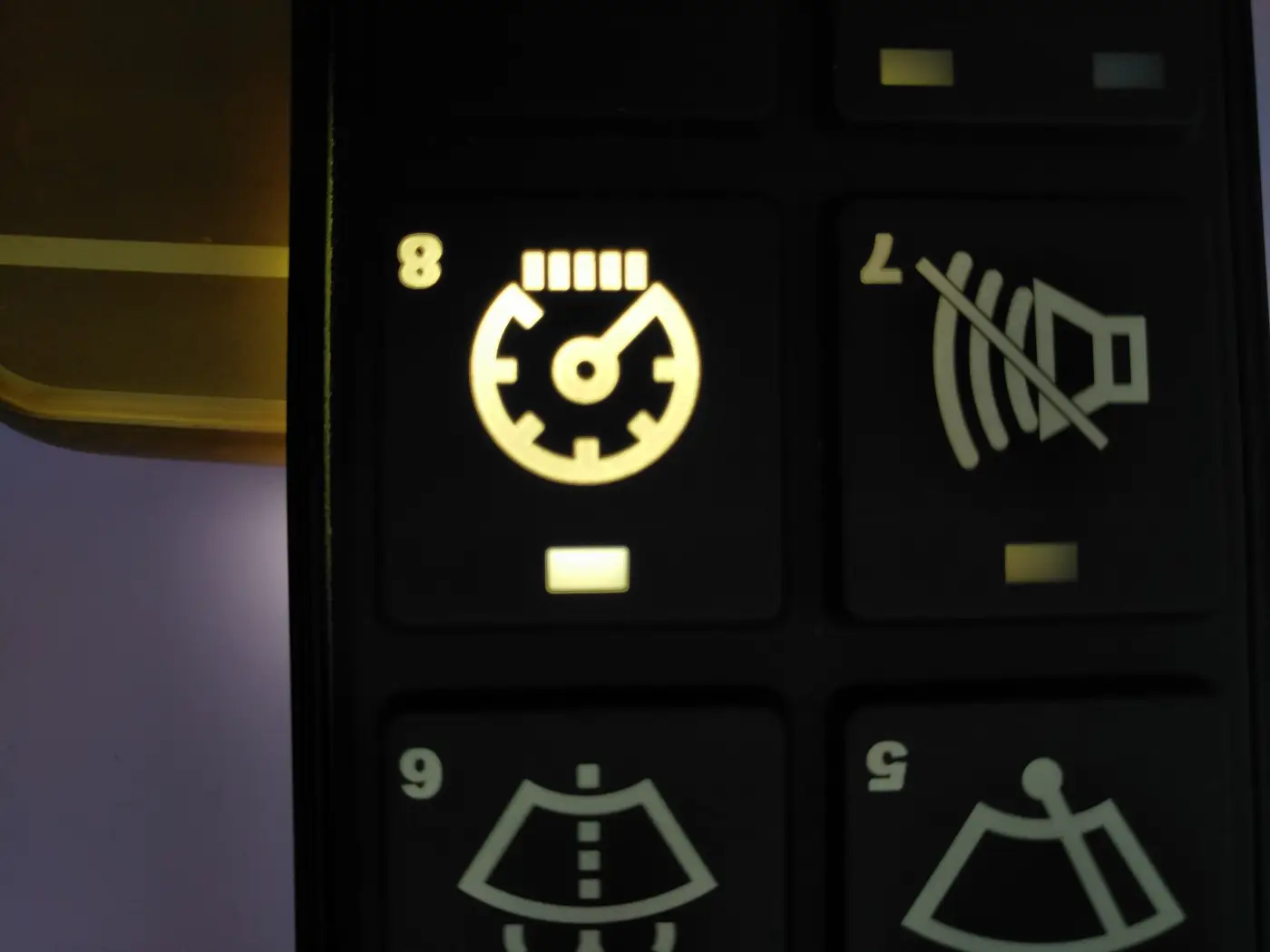
Uniformity is measured, not judged
The practical test is a photograph of the panel in a dark room at a fixed exposure, with the brightest and dimmest legend compared. A ratio inside a modest band reads as even to the eye; a ratio beyond it reads as a fault even when every key technically lights. Deciding the acceptable band before tooling turns a subjective argument into a pass or fail.
Power budget is part of the design
Backlighting a panel of eight keys from one LED is a diffuser problem; from eight LEDs it is a power and heat problem. Battery products usually need the first, mains products can afford the second. That choice changes the light guide and the legend layout, so it belongs in the first conversation.
Commissioning a custom backlit silicone keypad
Send the legend artwork with the lighting zones marked, the LED layout and the force target. The silicone keypad manufacturing section covers the moulding routes, and the IP67 membrane keypad page shows a sealed backlit construction.
Why is my backlit keypad uneven?
Usually because the LED count or position was fixed before the legend layout, or because the compound diffuses more than the design assumed. Both are correctable at the design stage, not after the tool.
Can any legend be backlit?
Any legend can be lit; not every legend can be lit evenly. Fine strokes and large solid areas need different wall thicknesses, so a panel mixing both usually needs a compromise or a two-route mask.
Does backlighting weaken the key?
It changes the wall under the legend, which changes the force. That is why the web profile is designed after the lighting decision rather than before it.
Brightness and uniformity depend on the LED, the compound and the wall together. Values should be confirmed on a lit sample photographed under fixed conditions, not on an unlit part.
For a backlit panel programme, send the legend artwork and LED layout through the custom silicone quotation route.