
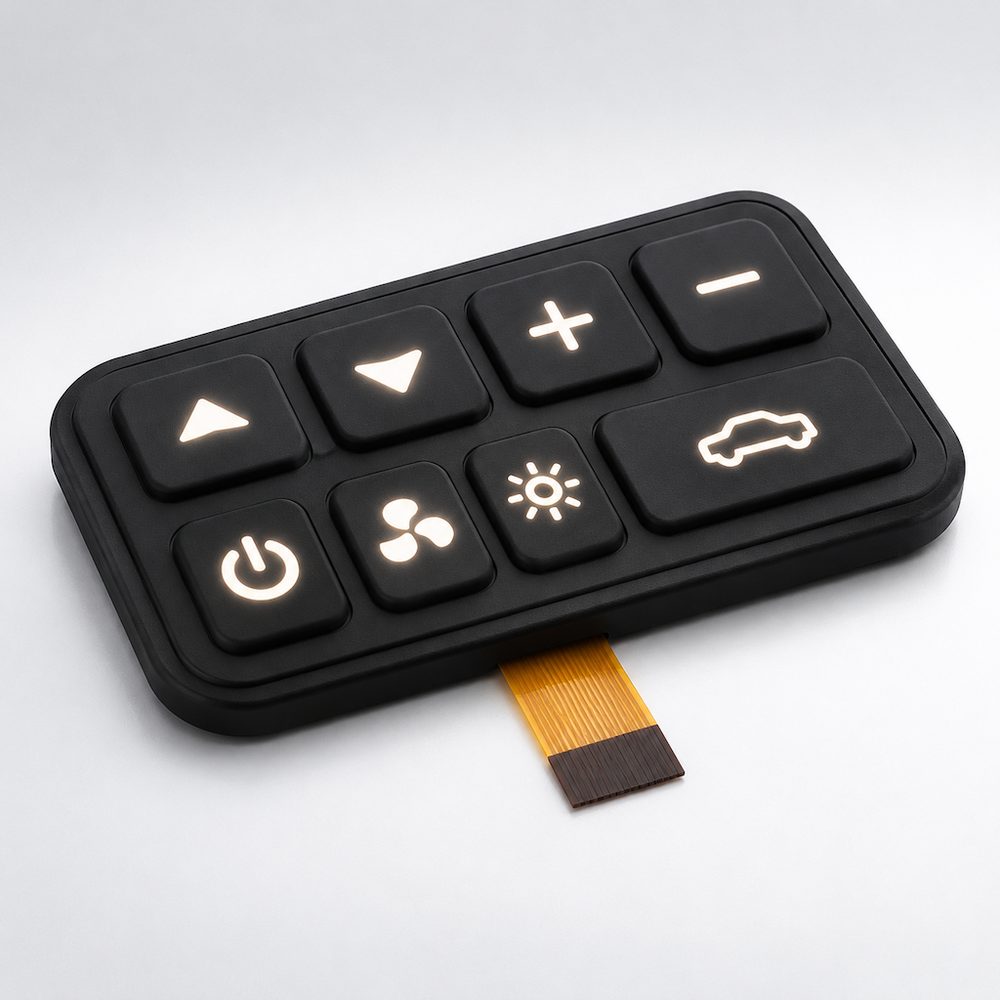
FromRubber Waterproof Backlit Rubber Keyboard For New Energy Electromobile


- group name
- Custom Silicone Rubber keyboards
- Min Order
- 1000 piece
- brand name
- FromRubber Silicone & Plastic OEM Manufacturer
- Nearest port for product export
- FOB shenzhen
- Delivery clauses under the trade mode
- FOB, CFR, CIF, EXW, FCA, DDP, Express Delivery
- Acceptable payment methods
- T/T, D/P D/A, Credit Card, PayPal, Westem Union, Cash
- update time
- Fri, 13 Nov 2026 12:20:41 GMT
Paramtents
Design Follow 3D Drawing Or Physical Object
Printing Laser Etching
Feature Backlight,Waterproof
MOQ 1000pcs
Application Electromobile
Packging & Delivery
-
Min Order1000 piece
Briefing
Detailed
Waterproof Backlit Rubber Keyboard for New Energy Electromobiles: Condensation Is the Real Threat
A keyboard in an electric vehicle is not usually exposed to rain. It is exposed to condensation - a cabin that heats and cools daily, a cold-soaked car driven into a warm humid day, and a driver with wet hands. Water arrives as dew, not as a splash. That changes the design: the seal has to survive repeated small pressure cycles rather than one immersion event, and the backlight has to keep working when moisture is present inside the housing.
Electromobiles add one more constraint. Where the panel sits near high-voltage equipment, creepage and clearance distances matter, and the keyboard's own materials and clearances become part of that assessment.
- Seal designed for thermal cycling and dew, not only for splash
- Pressure equalisation so the housing does not draw moisture in
- Backlight that tolerates humidity and does not fog the legend
- Clearance discipline where the panel is near high-voltage parts
Where the Water Comes From
Three sources dominate in a vehicle cabin, and only one of them is obvious.
Condensation and Dew Cycles
Warm humid air meets a cold panel surface and water condenses directly on it. If the housing is sealed, the daily temperature cycle also pumps air past the weakest seal as internal pressure changes. A membrane vent equalises that pressure without admitting liquid - which matters more here than a thicker gasket.
Cleaning Agents
Interior panels are wiped with cleaners that contain surfactants and sometimes solvents. These wet the surface better than water and find gaps a splash test would not. The seal and the legend both have to be checked against the actual cleaning chemistry, not against water alone.
Creepage and Clearance Near HV Equipment
Where the keyboard wiring runs close to high-voltage components, the surface condition of the plastic and the distance between conductors become safety parameters. Material tracking resistance, contamination level and clearance are specified by the vehicle's electrical safety assessment, and the keyboard supplier needs those requirements before choosing a compound.
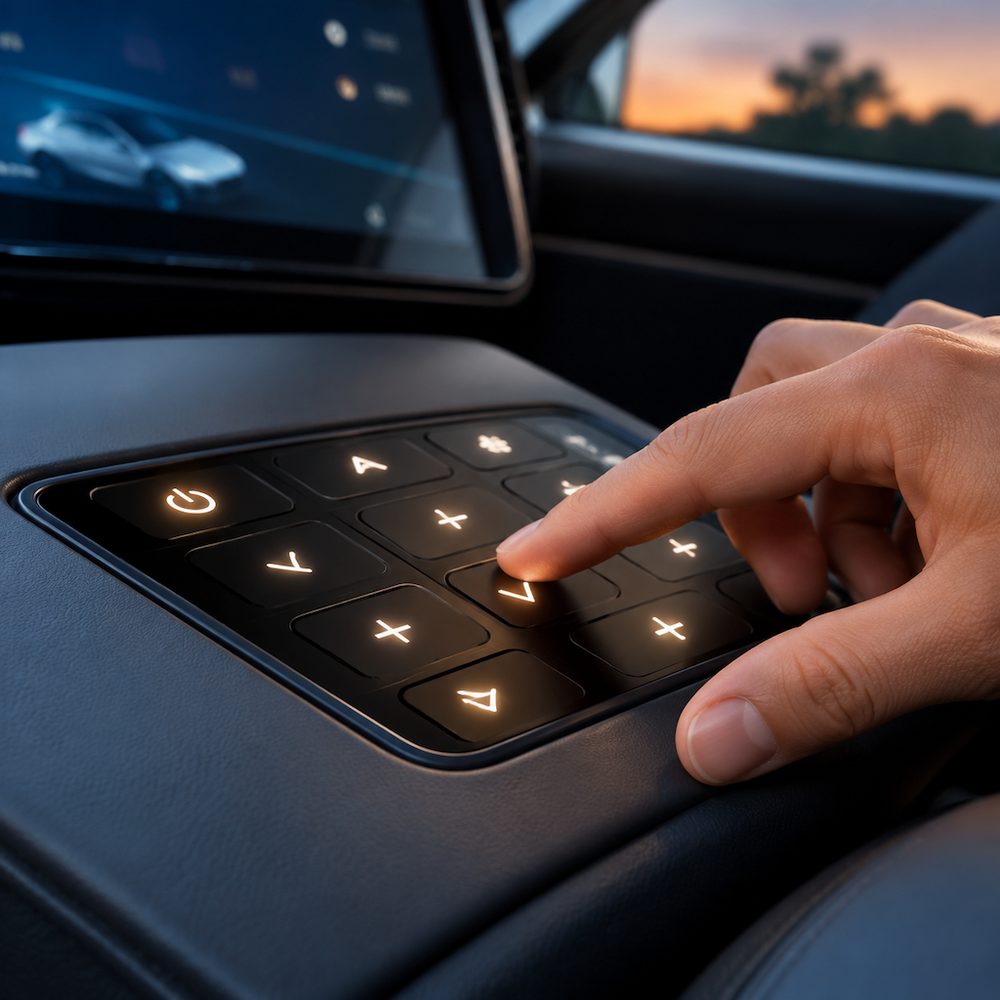
Specification Envelope for a Vehicle Backlit Keyboard
The envelope below is a starting point for a cabin-mounted backlit rubber keyboard. The vehicle's electrical safety and validation requirements govern the final specification.
| Parameter | Typical envelope | Why it drives the result |
|---|---|---|
| Material | VMQ silicone, two-layer for backlight | Opaque skin plus translucent core for etched legends |
| Seal strategy | Perimeter seal plus membrane vent | Dew cycles need pressure equalisation, not only a gasket |
| Etch depth | Verified per compound and colour | The main cause of legend brightness variation |
| Operating temperature | Designed across the cabin range | Cold stiffens keys, heat relaxes the web |
| Surface resistance | Per the electrical safety assessment | Relevant near high-voltage equipment |
| Cleaning resistance | Tested against actual interior cleaners | Surfactants find gaps water does not |
| Dimming range | Legend legible at minimum, no glare at maximum | Ties the panel to the interior lighting |
Ranges describe a typical design envelope. Final material, clearances and validation criteria are set by the vehicle programme and its electrical safety assessment.
Laser Etching and Backlight Under Humidity
Most automotive backlit keyboards use a laser-etched legend in a two-layer silicone construction. Etch depth is the variable that decides whether the result looks engineered or improvised.
Etch Depth Consistency
The laser removes the opaque top layer to expose the translucent layer below. If it cuts too shallow the legend is dim and patchy; if it cuts into the translucent layer unevenly, brightness varies across the panel. Depth is verified on coupons and monitored through the batch, because laser output drifts with lens condition and focus.
Test Etching Before the Run
Before a production run, the settings are proven on a scrap part from the same compound and colour. Laser absorption depends on pigment loading, so a colour change means a new parameter set. This single step prevents most legend rejects.
Humidity and Fogging
Moisture between the light guide and the legend diffuses light and makes the key look milky. Sealing the light path, or leaving a controlled vent path that does not trap water, keeps the appearance stable. Backlighting methods are compared in Can silicone keypads be backlit, and what are the common.
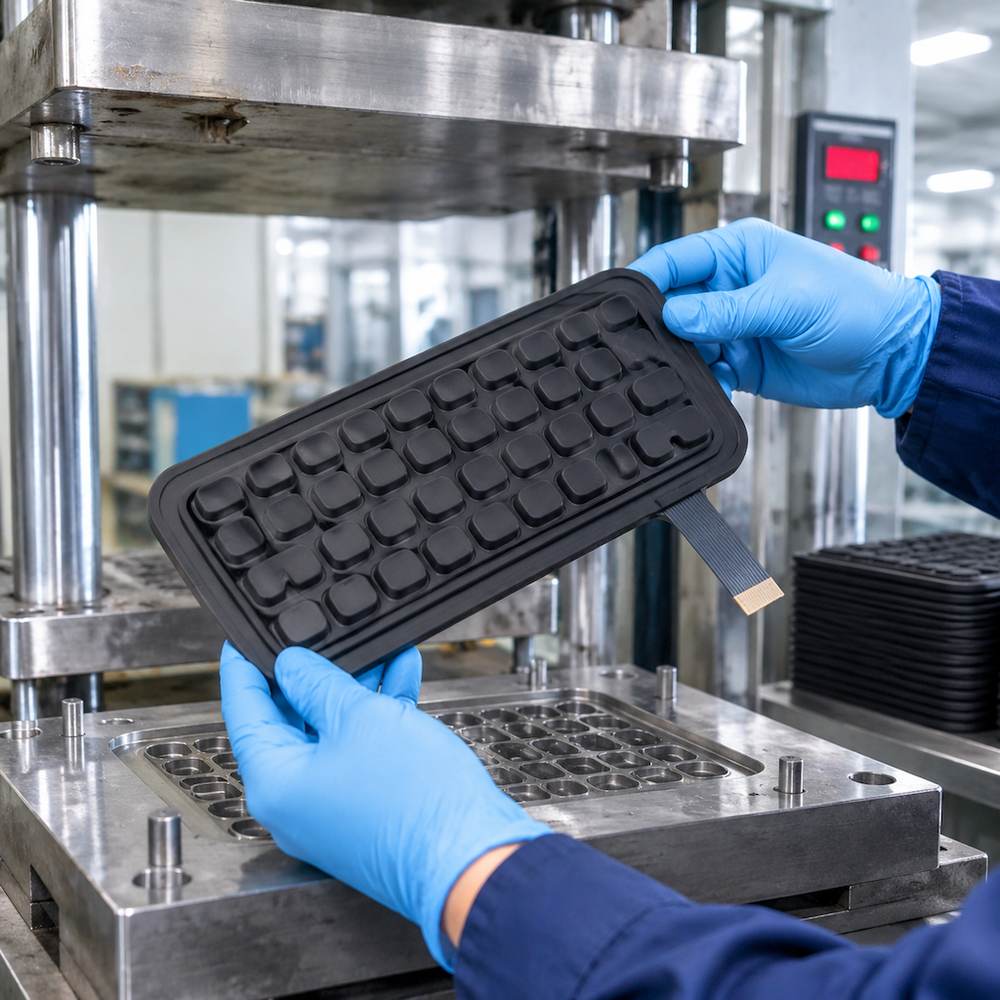
Dimming, EMC and Switch Behaviour
The keyboard is an electrical component as well as a mechanical one, and the electrical choices show up as light quality and as interference.
Dimming Across the Cabin Range
Legend brightness is tied to the interior dimming bus. The legend has to stay legible at the lowest setting and not glare at the highest. Specifying transmission at both ends, rather than at nominal, is what makes the panel feel consistent with the rest of the interior.
EMC and Grounding
LED wiring running near motor drives and HV cabling can couple noise into the light circuit, producing flicker. Twisting the LED pair, grounding the light circuit at one point and keeping the run away from drive cables solves most of it. The keyboard's conductive parts, if any, need to be bonded deliberately rather than incidentally.
Switch Bounce and Contact Film
Conductive contact keypads generate bounce, and the controller's debounce has to be agreed with the keypad's resistance range. A film of moisture or cleaner residue on the contact raises resistance and lengthens the bounce - the same mechanism that makes a wet key feel unresponsive. Sealing practice at the panel interface is covered in Silicone Keypad and Plastic Enclosure Waterproof Sealing.

New Energy Vehicle Keyboard Questions
Is waterproofing different in an EV cabin?
Yes. The dominant moisture source is condensation from daily temperature cycles rather than rain. That makes pressure equalisation and seal resilience more important than a single high-pressure splash rating.
Why does the backlight look patchy after a colour change?
Laser absorption depends on pigment loading. A new colour needs a new parameter set, proven on a scrap part from the same compound before the run. Skipping that step is the usual cause.
Can the keyboard be supplied as a backlit assembly with the PCB?
Yes. Supplying the keypad with the light guide, LED board and connector moves the optical and EMC responsibility to one supplier, which removes the interface disputes that appear when three parties each own part of the light path.
Send the Panel Drawing and the Cleaning Spec
Send the panel drawing, the illumination and dimming requirement, and the interior cleaning chemistry. We will review the seal strategy, etch depth and dimming range. Related: keypad and enclosure sealing and backlighting methods.
Request a keyboard design reviewFromRubber moulds backlit silicone keyboards for vehicle and equipment programmes. We do not sell retail.