
Custom Injection Molded Plastic Enclosure for Wireless Gateway Router


- group name
- Custom Plastic Enclosure
- Min Order
- 1 piece
- brand name
- FromRubber Silicone & Plastic OEM Manufacturer
- Nearest port for product export
- FOB shenzhen
- Delivery clauses under the trade mode
- FOB, CFR, CIF, EXW, FCA, DDP, Express Delivery
- Acceptable payment methods
- T/T, D/P D/A, Credit Card, PayPal, Westem Union, Cash
- update time
- Sun, 15 Nov 2026 05:20:05 GMT
Paramtents
Design 3D Drawings or Objects
Surface Polishing
Service Free Consult
MOQ 1000pcs
Application Wireless Gateway Router
Packging & Delivery
-
Min Order1 piece
Briefing
Detailed
Injection Moulded Plastic Enclosure for a Wireless Gateway Router: RF Comes First
A router enclosure is an RF component that happens to be made of plastic. The wall between the antenna and the room attenuates the signal, the material's dielectric constant detunes the antenna, and any conductive paint or metallised logo in the wrong place blocks it. Designing the enclosure around the appearance first and the antenna second is how a gateway ends up with half its rated range.
The practical order is: fix the antenna position and the required clearance, then choose material and wall thickness for RF transparency, then resolve thermal and mechanical needs inside that constraint. Appearance and tooling follow, not the other way round.
- Material and wall thickness reviewed against the RF band in use
- No metallisation, conductive coating or dense pigment over the antenna window
- Vent and slot geometry sized for airflow without becoming an ingress path
- Bosses and ribs placed away from the antenna keep-out zone
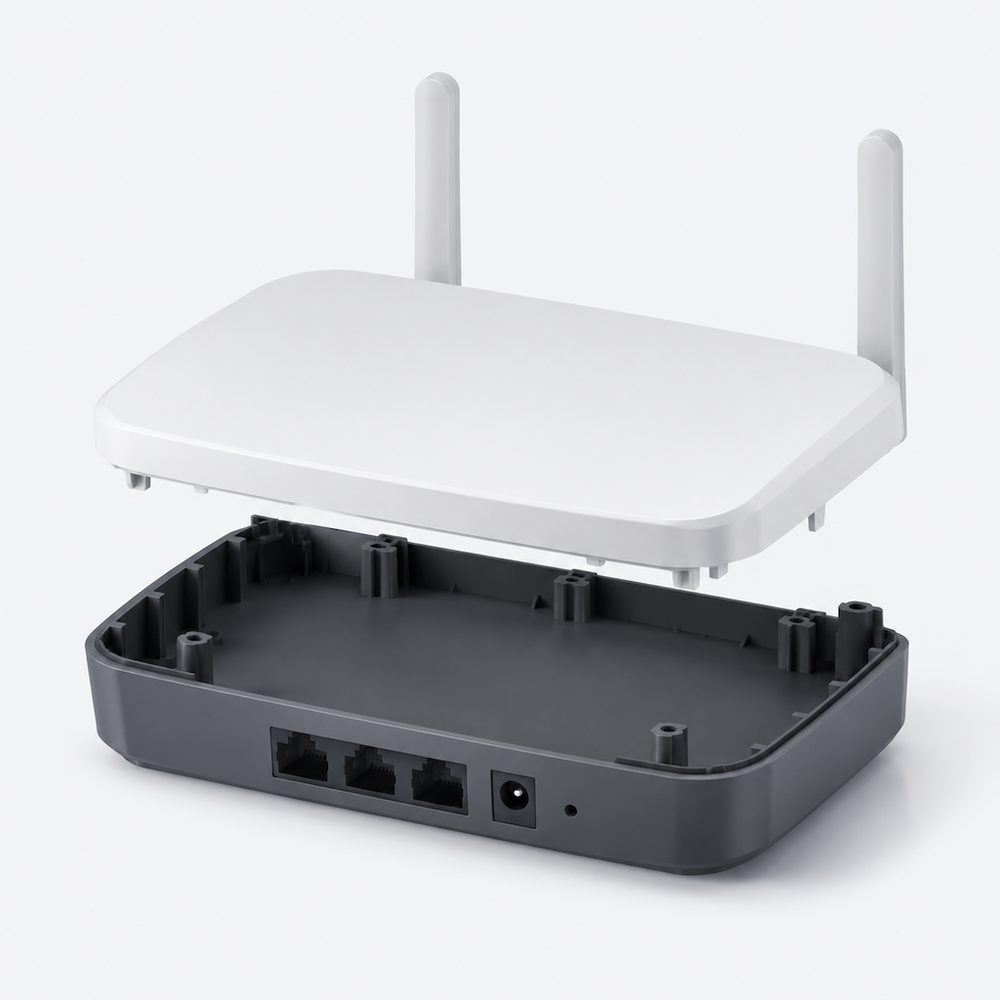
Material Choice and Antenna Window
Plastics are broadly transparent at 2.4 and 5 GHz, but not equally. The differences that matter are dielectric constant, loss tangent and how much of each sits in the antenna's near field.
Dielectric Constant and Loss
At Wi-Fi frequencies, common enclosure resins sit in a narrow band of dielectric constant, with ABS typically a little higher and PC a little lower. The exact value shifts the antenna's resonant frequency, so the antenna is tuned with the enclosure in place - never in free air. A material change late in the programme means retuning, which is why the resin should be locked before the antenna is matched.
Wall Thickness in the Antenna Path
Thickness and dielectric constant together set the electrical path length. A 2 mm wall and a 3 mm wall behave differently, and a local thickening to add a boss in front of the antenna is worse than the average thickness suggests. Where the housing needs structure near the antenna, move the structure rather than thickening the window.
Coatings, Paint and Metal
Conductive coatings, metallic flakes, chrome-look paint and metal logo badges all block or detune RF. If the design needs a metallic appearance, keep it outside the antenna window and specify a non-conductive alternative in the window. This is a specification point for the painter as much as for the moulder.

Specification Envelope for a Gateway Router Enclosure
The envelope below is a starting point for a fanless desktop or wall-mounted gateway enclosure. Antenna design and the RF band set the final wall and material decisions.
| Parameter | Typical envelope | Why it drives the result |
|---|---|---|
| Material | ABS or PC/ABS, low-loss grade | Dielectric behaviour and impact strength in one resin |
| Wall thickness | 1.8-2.5 mm | Sets RF path length and structural stiffness |
| Antenna window | No metal, no conductive coating | Metallisation in the window blocks or detunes the antenna |
| Vent area | Sized to the thermal load, baffled | Airflow without a straight path for dust and water |
| Flammability | UL 94 rating per the grade and colour | The listing belongs to the specific material, not the family |
| Joint design | Tongue and groove with a defined gap | Controls appearance gap and dust ingress |
| Boss design | Wall 0.6 of nominal, radius at root | Limits sink and creep under screw load |
Ranges describe a typical design envelope. Final wall thickness, material grade and compliance documentation are fixed against the antenna design and the customer's safety requirements.
Dropouts, Heat Rise and Creep
Most gateway field complaints trace back to the enclosure in one of three ways, and none of them look like an enclosure problem at first.
Antenna Detuning From the Environment
A gateway placed on a metal shelf or against a wall behaves differently from one on a test bench. Part of that is the enclosure's own material, part is what the customer puts it near. Specifying a low-loss material and keeping the antenna window free of metal removes the variables the supplier actually controls.
Thermal Rise Without Vents
Sealed enclosures with a fanless design rely on surface area. Vents help, but each vent is also a path for dust. The usual compromise is a chimney arrangement with an internal baffle, or a ventilated base with a solid top. Where IP rating is required, a membrane vent maintains pressure equalisation without admitting water. Enclosure-level practice is covered in Waterproof Plastic Enclosures for Switches.
Creep at Screw Bosses
Sustained load on a boss in a warm enclosure causes creep, and the joint loosens. Boss wall thickness, a radius at the root, and a thread-forming screw designed for plastic all reduce it. Where the enclosure is opened in service, metal inserts are worth the cost.
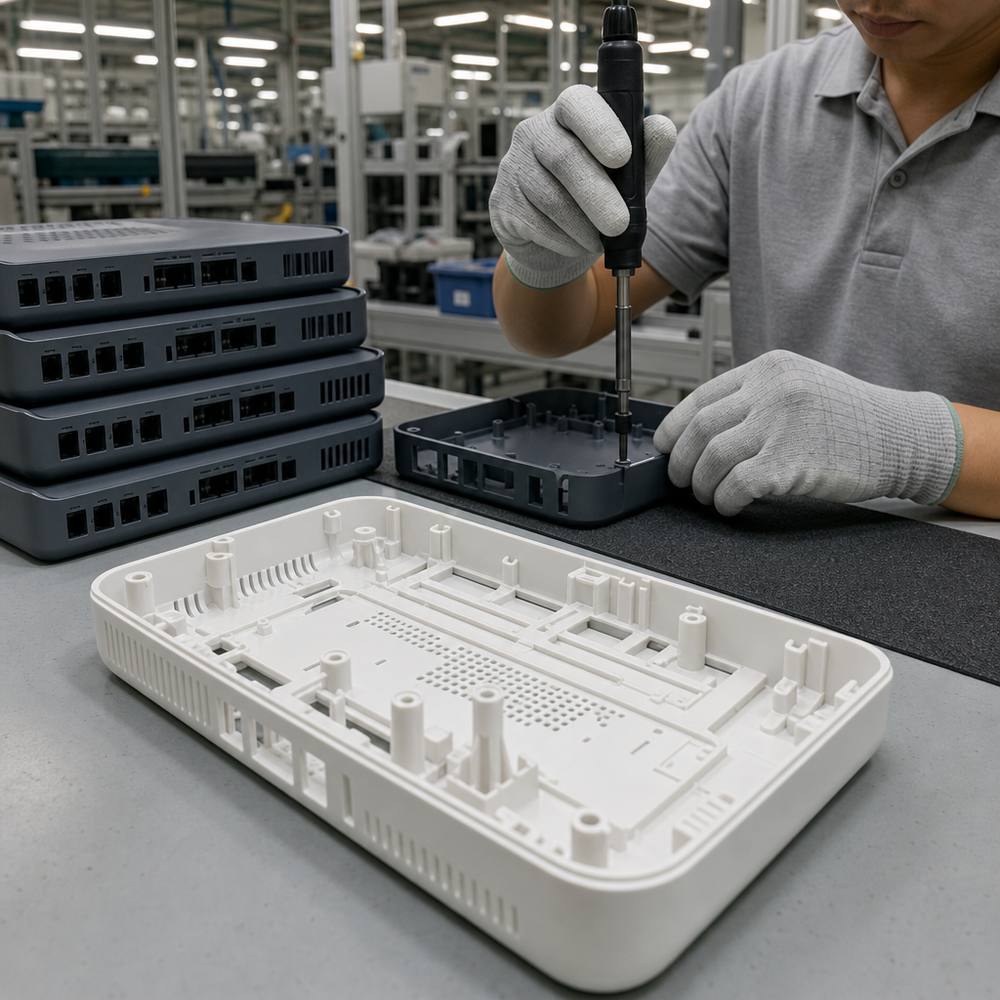
Tooling, Flammability and Compliance
Consumer network equipment carries flammability and safety expectations that shape both material and documentation. These are agreed at quotation, not discovered at first article.
Flammability Documentation
Enclosure resins are usually specified to a UL 94 rating, and the rating belongs to the specific grade and colour, not to the family. A colour change can invalidate the listing if the pigment system is different. Ask for the grade's certification rather than accepting a general statement.
Cavity Count and Cost
Router shells are typically produced in a single or two-cavity tool. Where volume justifies more cavities, the RF window and the appearance surfaces should still be reviewed per cavity, because cooling differences between cavities show up as dimensional variation on the joint line.
Supplier Evaluation
Buyers comparing sources should look at tool maintenance, colour consistency and how the supplier handles engineering changes. How to Choose a Plastic Enclosure Injection Molding Factory sets out the questions worth asking, and ABS, PC, or Reinforced Nylon? covers the material selection logic for enclosures of this type.
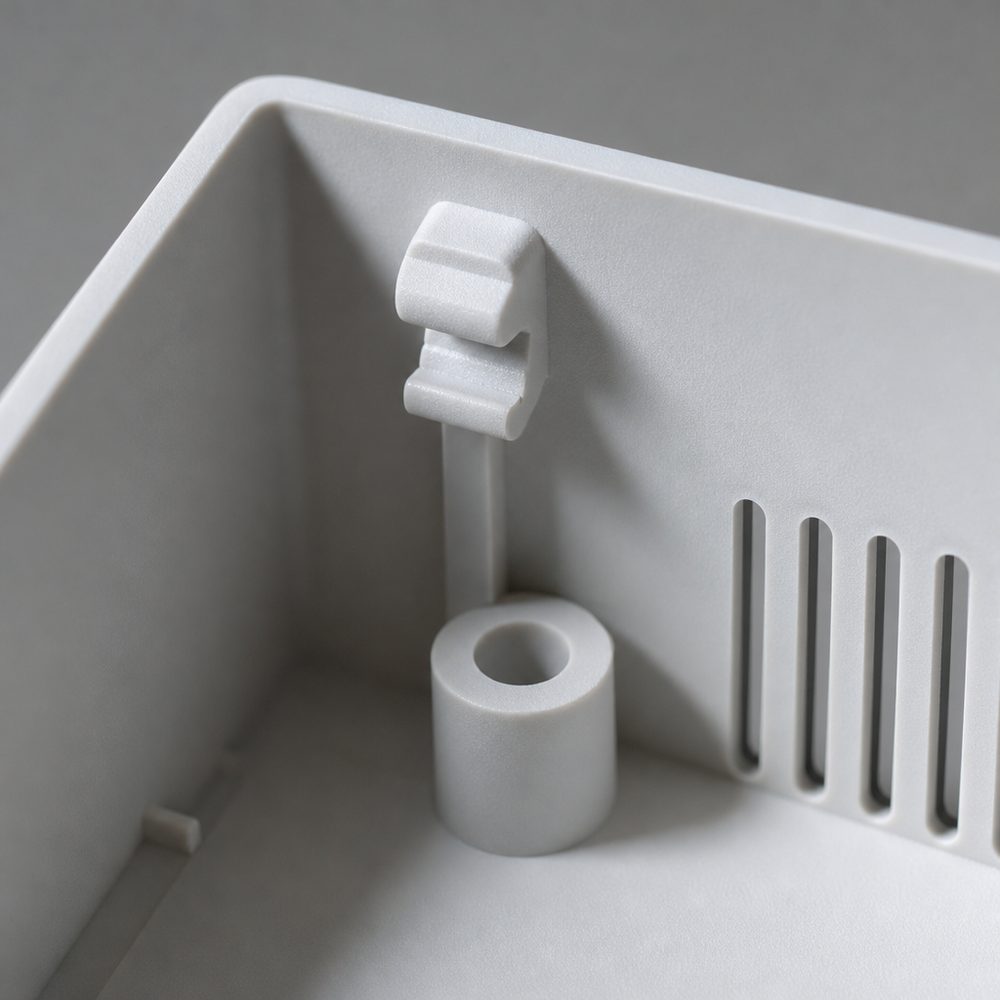
Gateway Enclosure Questions From Buyers
Does the plastic really affect Wi-Fi range?
Yes. Wall thickness and dielectric constant change the antenna's electrical environment, and conductive decoration blocks it outright. The antenna is matched with the production enclosure in place; changing the resin or the wall after matching costs a retune.
Can the enclosure be painted metal-look?
A metallic-looking coating outside the antenna window is workable if it is genuinely non-conductive or kept clear of the RF path. Conductive paint over the window is not. This has to be specified to the coating supplier, not assumed.
What about IP rating and ventilation at the same time?
They conflict, so the requirement has to be chosen. A membrane vent equalises pressure and keeps water out while allowing air exchange; open slots give better thermal performance and no ingress protection. Most gateways choose one and design around it.
Share the Antenna Layout With the Enclosure Drawing
Send the enclosure 3D file, the antenna position and keep-out zone, the RF band and the thermal load. We will review material, wall thickness in the RF path and vent geometry before tooling. Related: enclosure IP ratings and evaluating enclosure suppliers.
Request an RF-aware DFM reviewFromRubber moulds plastic enclosures for OEM network and equipment programmes. We do not sell retail.