
Transparent Rubber Keypad Custom Strong Transmittance Silicone Inner Keyboard


- group name
- Custom Silicone Rubber Inner Keypad
- Min Order
- 1 piece
- brand name
- FromRubber Silicone & Plastic OEM Manufacturer
- Nearest port for product export
- FOB shenzhen
- Delivery clauses under the trade mode
- FOB, CFR, CIF, EXW, FCA, DDP, Express Delivery
- Acceptable payment methods
- T/T, D/P D/A, Credit Card, PayPal, Westem Union, Cash
- update time
- Sat, 28 Nov 2026 22:33:22 GMT
Paramtents
Design Follow 3D Drawing Or Physical Object
Printing Silk Screen Printing
Conduction Mode Conductive Carbon Pills
MOQ 1000pcs
Application PSP Game Console
Packging & Delivery
-
Min Order1 piece
Briefing
Detailed
Transparent Rubber Keypad With High Transmittance: Designing Backlit Silicone Keys That Stay Clear
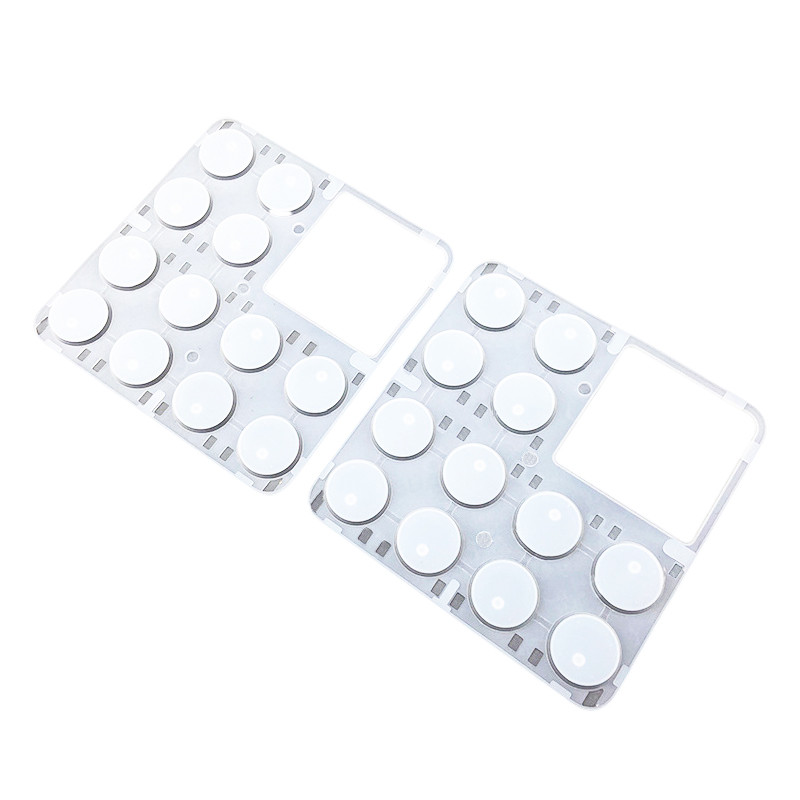
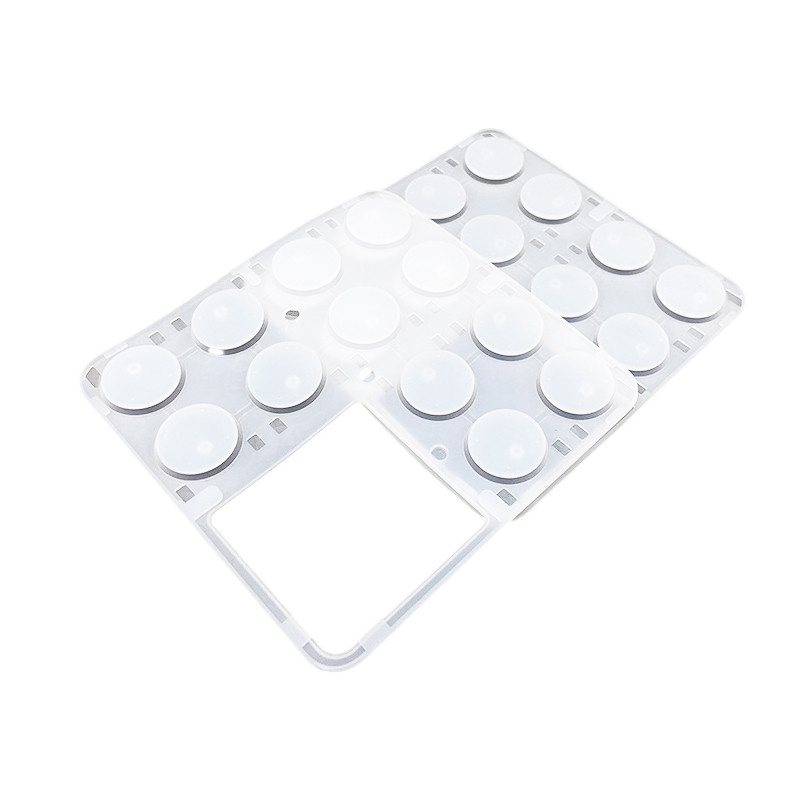
A clear silicone keypad is specified when the legend has to light up through the key body rather than sit on top of it. The moment that decision is made, three new requirements appear: transmittance, haze, and colour stability over the life of the product. This page covers how each is controlled in the compound, the geometry and the mould, and how the numbers are specified so a supplier can be held to them.
Cure, Not Only Compound, Sets the Colour of a Clear Keypad
Under-cure shows up first against a white LED
Yellowing in a translucent silicone keypad is usually described as a material problem, but it is more often a cure problem. An under-cured translucent compound keeps reactive groups that continue to react slowly in service, and the visible result is a shift towards amber that shows up first against a white LED. Over-cure creates the opposite issue: a slight but permanent tint that is present from first article.
Compound choice sets the ceiling. Translucent grades differ in base colour, in the amount of reinforcing filler and, importantly, in how they behave under prolonged light. Where the keypad is backlit continuously, the specification should include a light-ageing check on the moulded part, not only a transmittance reading taken on a plaque at day one.
- Verify cure on the moulded part, not only on a test plaque
- Specify light ageing as well as initial transmittance
- Compare colour against the actual LED colour temperature used in the product
Transmittance and Haze: Two Numbers, Not One
Wall thickness and light path
Transmittance tells you how much light passes through; haze tells you how much of it is scattered. A keypad can have high transmittance and high haze, which reads as a soft, evenly lit key, or high transmittance and low haze, which reads as a bright but directional key with a visible hot spot. Neither is universally better; the requirement depends on whether the light source is a single LED under the key or a light guide behind the whole panel.
Wall thickness changes both numbers at once. A thicker key wall absorbs more light, so keys of different heights in the same keypad will not appear equally bright unless the light path is designed for it. Where a keypad has tall keys next to flat ones, the tall keys are usually moulded thinner at the light path or given a separate diffusion feature so the panel reads uniformly.
- Specify transmittance and haze together, with the measurement thickness
- Balance light paths across keys of different heights
- Confirm brightness uniformity on the assembled backlight, not on a single key
Key Geometry for Even Backlight
Diffusion, light guides and hot spots
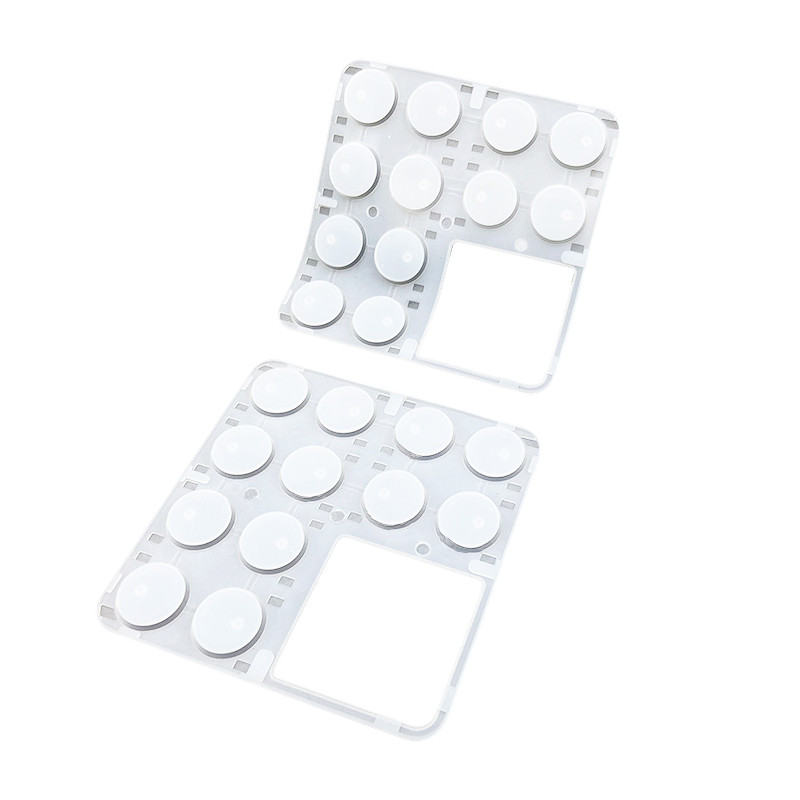
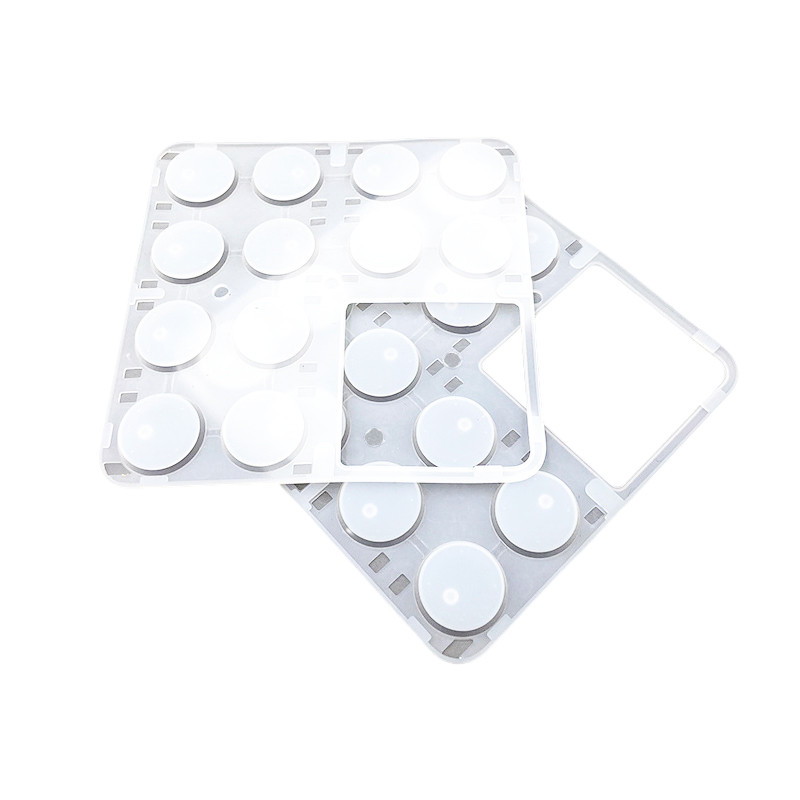
A single LED directly under a clear key produces a bright centre and a dark rim. The standard fixes are a textured back surface to scatter light, a thicker diffusion zone above the LED, or an opaque wall that stops light leaking between neighbouring keys. Light leakage is the more serious defect, because it makes two adjacent keys look like one blurred area.
Opaque separation is created either by a second moulded material or by a printed light-blocking layer on the back of the keypad. Printing is cheaper and works well when the keypad is flat; moulded separation holds up better where the key web flexes, because a printed layer on a flexing web can crack over time.
- Use a textured back surface to scatter a point source
- Block light between keys with an opaque wall or a printed barrier
- Prefer moulded separation where the web flexes repeatedly
Moulding Clear Silicone Without Contamination
Tool cleanliness, gate design and handling
Clear silicone shows contamination that coloured compounds hide. A speck of cured material from a previous run, a rust mark from a tool insert or dust transferred during packing all become visible once the key is backlit. Tool cleaning discipline is therefore part of the transmittance specification, not a housekeeping detail.
Gate position matters for a different reason. A gate on the light path leaves a mark that scatters light unevenly, and on a clear key it cannot be hidden with pigment. The gate is normally placed on a side wall or on a runner that is trimmed below the light path, and the trim is checked under backlight before the lot is accepted.
- Clean tools between translucent and coloured runs
- Keep the gate off the illuminated face
- Inspect trimmed gates under backlight, not in ambient light
Transparent Keypad Specification Fields
Transmittance, haze and colour are measured on the moulded key at the thickness stated on the drawing; the acceptance values are agreed per project.
- Part type
- Translucent silicone keypad for backlit keys
- Material
- Translucent silicone, grade selected for light stability
- Transmittance
- Target stated with the measurement thickness
- Haze
- Target stated together with transmittance
- Wall thickness
- Defined per key height to balance brightness
- Light control
- Textured back surface, diffusion zone or opaque separation
- Legend
- Laser etched or printed, aligned to the light path
- Colour stability
- Checked under light ageing on the moulded part
- Gate
- Placed off the illuminated face and trimmed below the light path
- Design input
- 3D drawing (STEP/IGS) plus 2D drawing, or a physical sample
- Minimum order
- 1000 pcs for this product family
Questions About Clear and Backlit Keypads
Can you supply a measured transmittance value?
Yes. Transmittance and haze are measured on the moulded key at an agreed thickness and reported with the measurement method, because a value quoted from a raw material data sheet does not describe the finished part.
Can a clear keypad be tinted?
It can, but tinting moves the part from a transmittance specification to a colour specification. Where a tint is needed, the colour and the light output are specified together and checked against the actual LED.
Will the keypad yellow over time?
Yellowing depends on the compound, the cure and the light exposure. A light-ageing check on the moulded part is the way to bound the risk; a colour reading at first article alone will not detect a slow shift.
How are legends applied to a transparent key?
Laser etching works well because the marking sits inside the material and the surrounding key body carries the light. Printed legends are used where multiple colours are required, with the ink selected for adhesion on a translucent surface.
Send the Backlight Layout With the Keypad Drawing
Share the keypad 3D model, the LED or light guide layout and the target brightness. The review returns the wall sections, diffusion and separation strategy, transmittance and haze targets and the gate plan for a clear part.